
News, stories and insights
December 12, 2025
COP30’s key insight: Scope 3
COP30 did not deliver a diplomatic breakthrough, but it revealed the real challenge of the decade ahead. Climate progress now depends less on new commitments and far more on our ability to understand and act on Scope 3.
Reliable data, harmonised emission factors, scalable LCAs and sector-wide collaboration will determine whether ambition becomes implementation.
Many sectors still lack these foundations. If yours has not begun this work, now is the time to lead.
Read our full analysis.
How Environmental Performance Becomes a Driver of Economic Efficiency in Water Treatment
It’s often assumed that reducing the environmental footprint of a process inevitably leads to higher costs. The Membratec case shows the opposite.
By analysing the key contributors to environmental impact—especially activated carbon and energy—we demonstrate that the levers that reduce environmental footprint are the very same levers that lower operating costs.
Even better: by choosing the right technology and structuring activated-carbon procurement around real performance criteria, it becomes possible to simultaneously improve treatment quality, material efficiency, and overall economic competitiveness.
An approach that challenges a persistent belief: sustainability and economic performance are not opposites — they can reinforce each other when decisions are grounded in solid data.
Read the article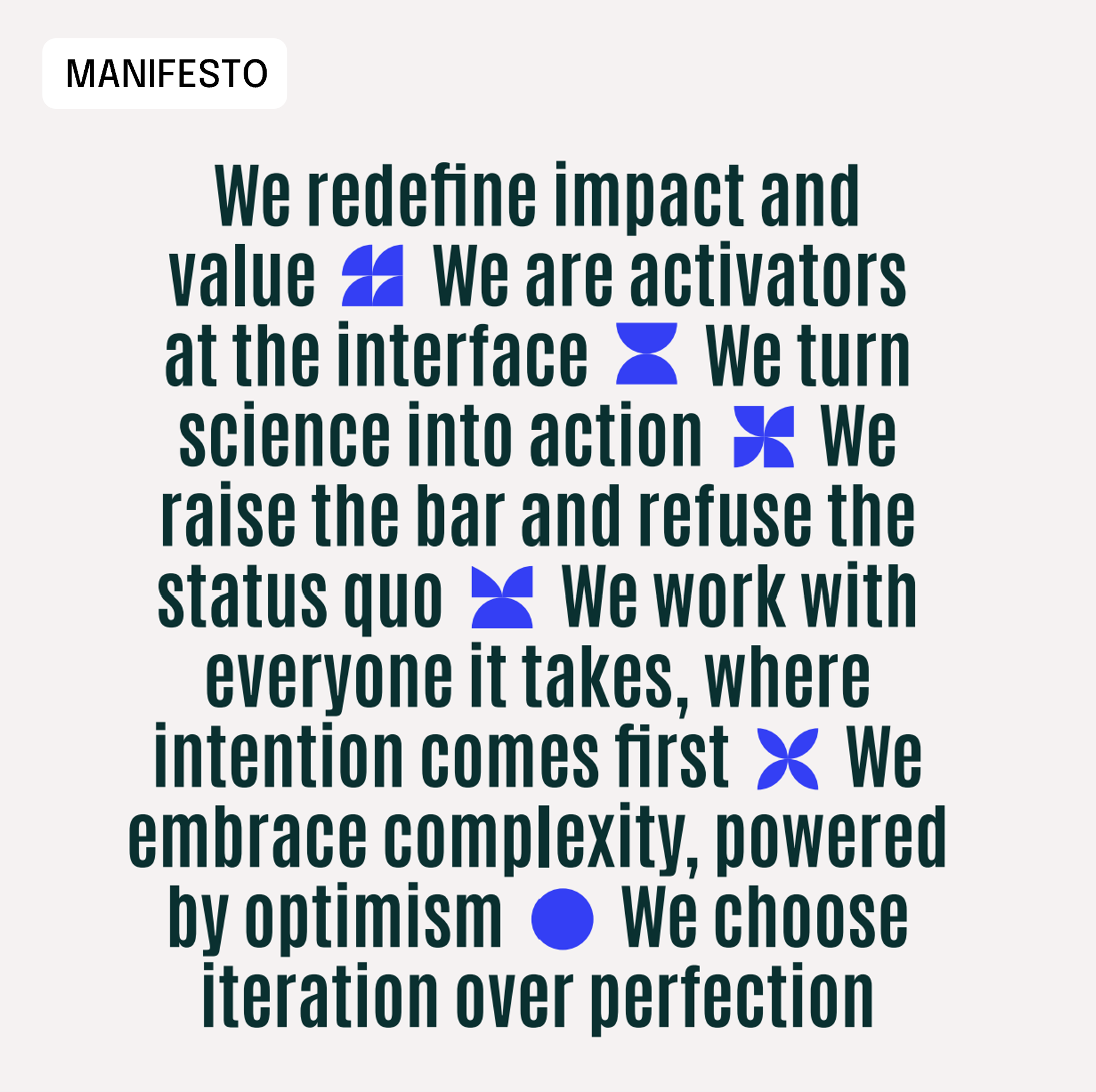
Introducing the Earth Action Manifesto 2025
Earth Action has released its first public manifesto, a compass for navigating systemic change within planetary boundaries.
It clarifies who we are, how we work, and why collaboration across worlds is essential to accelerate impact.
To mark its publication, we sat down with our co-founders, Sarah Perreard and Julien Boucher, for an honest conversation about why this manifesto was needed, how it was shaped by our team, and what it means for the years ahead.
Read the interview and discover the manifesto
Building Sustainable Finance in Service of the Company’s Mission
How can finance become more than an administrative function — and turn into a true lever for impact? In this month’s blog, Caroline Daumas (Rouge·Kaki) and Virginie Galdemar (Earth Action) share how a transparent, well-structured accounting partnership can transform the way an organization steers its mission.
From building a common financial language to using accounting as a strategic compass, their dialogue shows how aligned governance practices shape resilience, clarity and long-term impact.
PFN enters scientific review and prepares the 2026 cycle
This month, the Plastic Footprint Network reached an important milestone. All technical modules developed in 2025 have now been handed over to the Scientific Committee for review, ahead of publication in March 2026.
As we reach this transition point, we look back at three years of progress: new modules on long life items, release rates, agriculture and microplastics from packaging, major updates to tyres and textile microfibres, and the advancement of impact valuation and mitigation accounting.
The 2026 edition begins in April. If you wish to help shape the next cycle, now is the time to join.

INC-5.3: Resetting Plastics Treaty Talks
On 7 February 2026, governments will meet in Geneva an inter-sessional, procedural meeting aimed at preparing the next phase of the global plastics treaty process.
This one-day resumed session of the Intergovernmental Negotiating Committee will focus on electing a new chair and other officers, following stalled talks at INC-5.2.
While no substantive negotiations are planned, the meeting is critical for unblocking the process and preparing the ground for the next round of treaty talks on ending plastic pollution.
In Case You Missed It
Catch up on key reports, articles and consultations:
Plastic pollution can linger on the ocean’s surface for over a century
Coupling fragmentation to a size-selective sedimentation model can quantify the long-term fate of buoyant plastics in the ocean
Researchers modelled how floating plastics break down and sink…
Read the article
Extreme weather is making plastic pollution more mobile, more persistent and more hazardous
Plastic pollution under the influence of climate change…
A Frontiers in Science study finds that climate change is intensifying plastic pollution…
Read the article
Microplastics can spread pathogenic and antibiotic-resistant bacteria
Sewers to seas: exploring pathogens and antimicrobial resistance…
New research shows that microplastics rapidly accumulate biofilms…
Read the article
Reuse and return systems could eliminate most plastic packaging pollution by 2040
Breaking the Plastic Wave 2025…
Pew’s latest global analysis finds that pollution from plastic packaging…
Read the report
SBTi proposes more flexible pathways for companies to reach net-zero
SBTi proposes more flexible corporate Net Zero standard
The Science Based Targets initiative (SBTi) released a draft net-zero standard…
Read the article
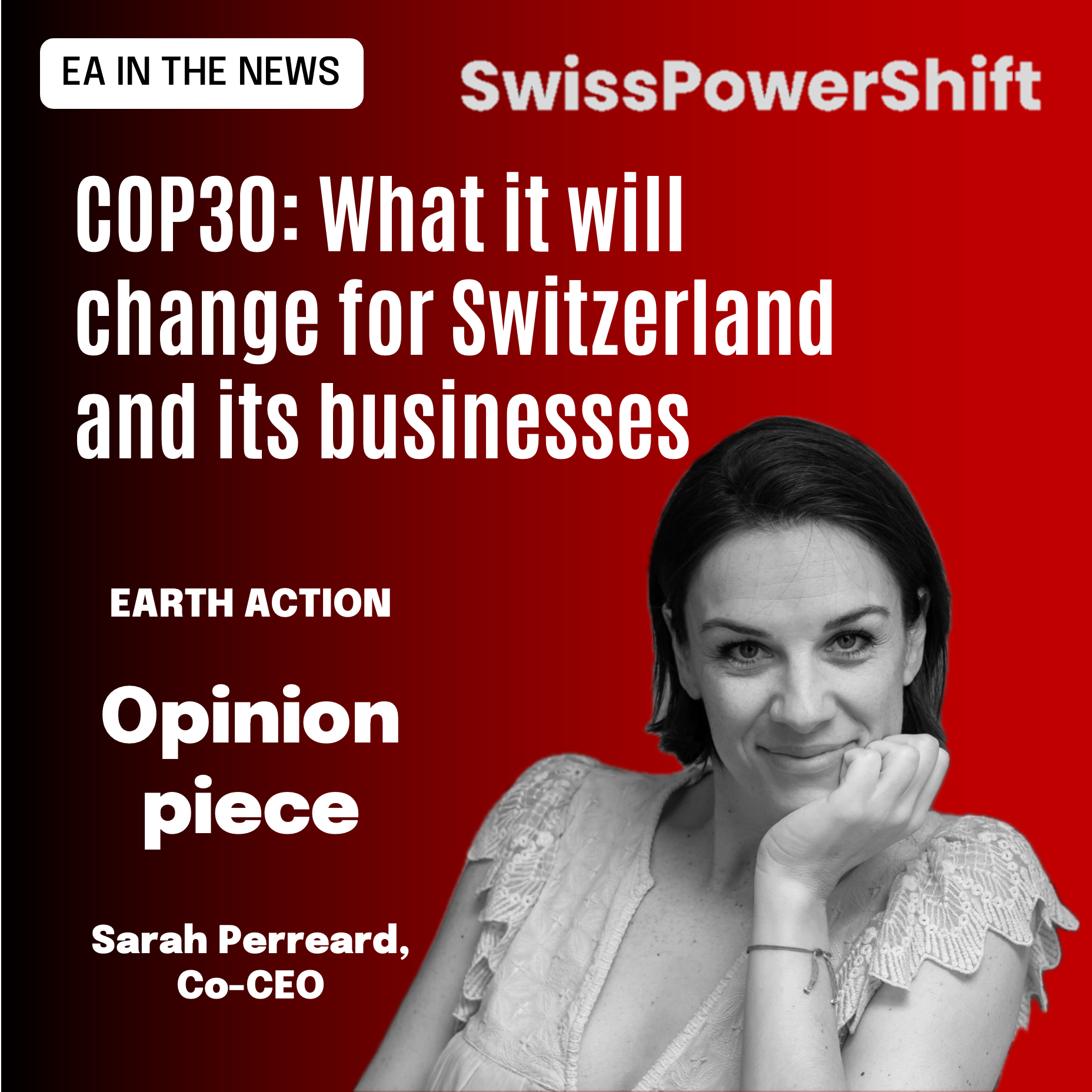
COP30: What it will change for Switzerland and its businesses
“Beyond the widely discussed diplomatic deadlocks, COP30 showed that the transition will no longer be driven by final communiqués, but by countries’ ability to measure, finance, and deploy real transformations,” explains Sarah Perreard.
For Earth Action’s co-CEO, “after a decade defined by commitments, innovation is no longer about technological novelty alone, but about demonstrating tangible impact.”
On our radar
Beyond our own work, we track key policy moves, insights, and analysis shaping the sustainability agenda. This section spotlights external developments and perspectives we think are worth your attention.
At global level, COP30 closed with the Belém Package, signalling steady but incremental progress as countries prepare the next round of climate transition planning.
On corporate climate action, the SBTi opened consultation on its revised Net-Zero Standard, with proposals that raise expectations on Scope 3 and transition planning while adding new flexibility through alignment-based methods.
Within the EU, co-legislators reached agreement on the Omnibus I package… consultation on the Circular Economy Act closed in early November…
In the United States, a federal appeals court temporarily paused California’s climate risk disclosure law (SB-261) while allowing the GHG emissions reporting law (SB-253) to proceed…
In Switzerland, new PFAS restrictions and a ban on intentionally added microplastics enter into force in December…
And in Germany, updated guidance under the Single-Use Plastics Fund introduces a 500-gram threshold…

Welcome Edouard !
We’re excited to welcome Edouard Cattin, joining Earth Action as an analyst. Edouard brings experience in LCA, carbon footprinting, climate adaptation, energy and climate strategy, waste management, and environmental labelling.
He holds a Master of Engineering from EPFL, with a focus on sustainability strategy and integrated design.
He is also a former municipal concilor, supporting local initiatives. Building on his expertise in the carbon domain, Edouard will also contribute to the Plastic Footprint Network, strengthening our work on plastic pollution impact assessment.

Happy holidays from the EA team!
As we reach the end of the year, we would like to thank you for your continued trust and collaboration.
Your engagement makes it possible to advance practical solutions and strengthen the foundations for real-world impact.
We wish you an excellent holiday season and a positive start to the new year!
The EA team
Thank you for reading the latest Earth Action Newsletter! If you found this issue valuable, please forward it to colleagues and invite them to subscribe!
Have ideas on how to make this newsletter more valuable to you? Let us know!


Lausanne, Ch. des Vignes d’Argent 7, 1004 Lausanne, Switzerland
You are getting this note because you subscribed to hear from Earth Action.
Don’t want to hear from us anymore ? Unsubscribe