
“… change needs wind in the sails, and it also needs seeds in the ground”
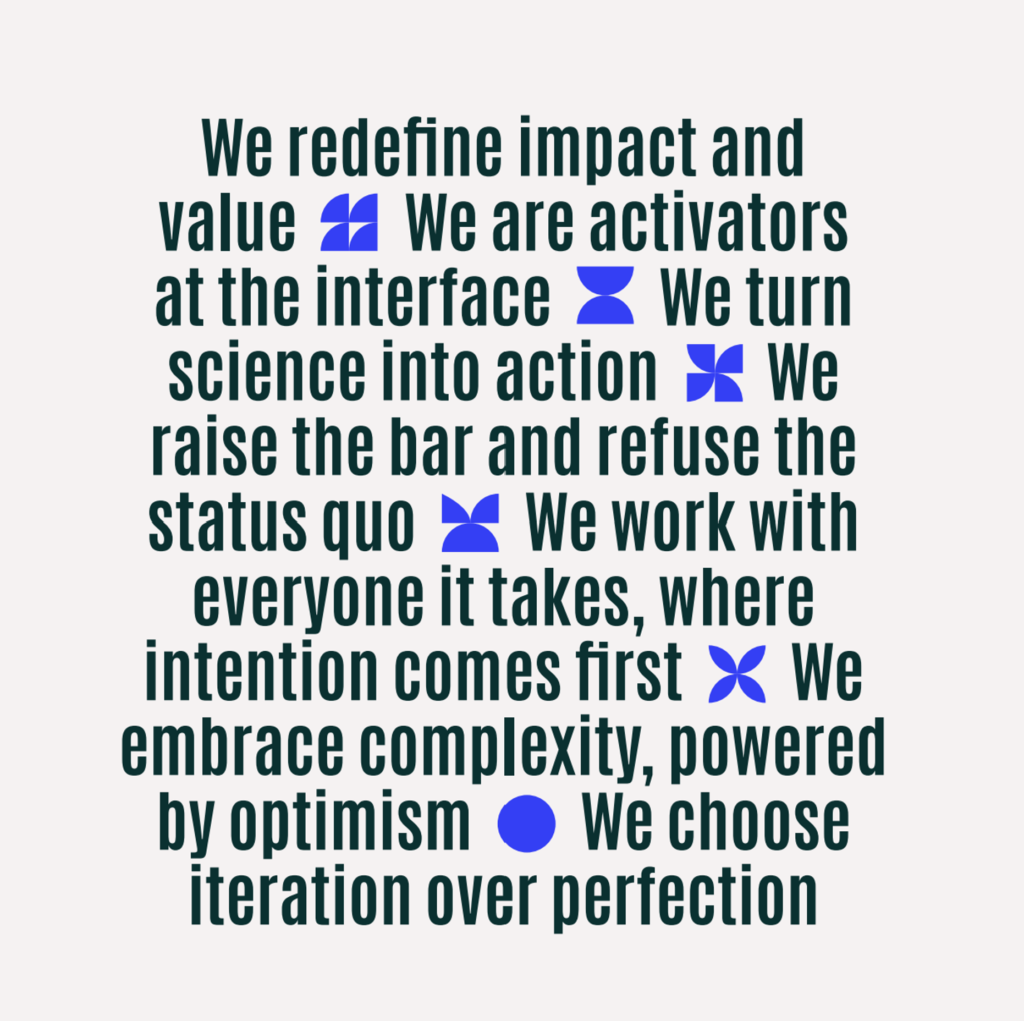
Earth Action has just released its Manifesto — a compass for navigating systemic change within planetary boundaries.
We sat down with co-founders Julien Boucherand Sarah Perreard to understand why now, what guided the writing, and how this manifesto reflects the identity and ambition of Earth Action.
Q: Why create a manifesto?
Julien :
From the start, we have been an impact company — created by impact-driven people. But with the flow of everyday work, you sometimes forget to pause, to put things on paper, to reflect on your deepest motivations.
Writing this manifesto was first and foremost an exercise for ourselves and for the team:
to step back, question what we’re doing, clarify why we’re doing it — and take pride in saying it out loud.
Of course, it is also a communication tool.
We want to tell our story, explain our intentions, and share the principles that guide us.
And it matters for new team members as well: it gives them a clear sense of who we are and what we stand for.
Sarah:
Yes — and communication is essential because we do get challenged sometimes.
Some people question why we work with industry.
Others question why we collaborate with NGOs.
What feels natural to us — working across worlds to unlock systemic change — is not always obvious from the outside.
The manifesto helps us articulate that clearly: our values, our boundaries, and the reasons behind our approach.
Q: The manifesto uses a sailing metaphor. Why?
Julien:
Because navigation is the perfect image for systemic transformation.
You don’t control the wind, the tides, or the currents — but you can learn to work with them, wisely and intentionally.
And, honestly, the metaphor speaks to us.
I’m a sailor, and sailing has always been a powerful analogy for many things:
reading complexity, adjusting course, embracing uncertainty, moving with intention.
It reflects how we navigate impact work.
Sarah:
The ancient fear of “falling off the edge of the world” mirrors today’s fear of crossing planetary boundaries.
Except that this time, the edge is real — and our role is to help chart a safe course.
And beyond that, the metaphor of the pirate speaks to me too.
There is so much to change in this world that sometimes you need to break the rules —
or at least refuse the status quo.
We really live for that.
And yes, it’s also because Julien is incapable of writing anything without a boat in it.
Julien:
Guilty… but this time it works.
Q: What does “impact” mean for Earth Action?
Sarah:
Impact means accelerating the transition toward a society that operates within planetary boundaries.
And for us, it’s very concrete:
- How decisions shift
- How investments evolve
- How behaviours change
- How value is created with less material and energy
But impact doesn’t happen by accident.
Our role is to bring the right information to the right people so they can make the right decisions.
We help organisations navigate this transition — reducing risks, building resilience, and aligning their operations with the limits of the planet.
Julien:
And for that, knowledge is essential — but knowledge alone is never enough.
The information we provide must be science-based, relevant, and above all actionable.
We’re not here to produce reports that sit on shelves.
We want to give a clear understanding of the system so that action becomes possible:
from eco-design to rethinking value chains to reshaping business models.
Sarah:
There’s also a third ingredient we deeply believe in: the information must be empowering.
Data only creates impact when it connects with people — with their motivations, their responsibility, their desire to contribute.
Because ultimately, systems change through humans.
In a way, this is our recipe for impact:
relevance, actionability, and engagement.
Q: You describe yourselves as “activators at the interface.” What does that mean?
Julien:
We don’t just analyse or advise. We activate.
We work where currents meet — where governments, businesses, academics, citizens, investors, and NGOs collide. It’s messy, but it’s where movement happens.
Sarah:
Being activators means we turn science into action.
We translate knowledge into actionable insights, into empowering narratives, into momentum.
We connect worlds that rarely speak to each other.
And when that connection happens, ambition becomes action.
Q: Some NGOs critique EA for ‘working with everyone.’ How do you respond?
Julien:
We hear this often. NGOs question our involvement with industry. Industry questions our closeness to NGOs.
But the truth is simple: systemic crises require systemic fleets. You cannot transform a system by working only with the actors who already agree with you.
Sarah:
And we must remember something essential.
Organizations are made of people.
And most people — whatever badge they wear — want to leave a good legacy.
When we work with individuals inside companies, and when we help them understand the impacts of their decisions, we are planting seeds.
Seeds that grow.
Seeds that influence teams, strategies, investments, and eventually industries.
I am not a sailor like Julien — I am more of a gardener — but both metaphors hold:
change needs wind in the sails, and it also needs seeds in the ground.
Julien:
And intention matters.
We work with anyone who shows a willingness to change.
We step back when engagement is used to block progress or dilute collective efforts.
Some of our most impactful work came from industries facing the largest environmental challenges. Working with them uncovered knowledge gaps that now inform policy and reshape markets.
And yes, some companies now avoid working with us because we raised the bar — and that is a sign we are doing our job.
Sarah:
Working with everyone does not mean accepting everything.
It means working where impact is possible and walking away when it isn’t.
Julien:
And we are also pragmatic.
We work with small businesses, SMEs, and large organisations — because change doesn’t happen in a single leap.
Every step forward counts, as long as we share the same horizon.
We’re happy as long as we’re making progress on the course, no matter the speed.
Some say it’s never fast enough, and yes — the urgency is real.
But we choose to stay on the journey with all of them, at different paces, because the problems we’re trying to solve are complex and multi-faceted.
There is no single truth, no silver-bullet solution.
So we must stay humble while remaining ambitious.
Finding that equilibrium isn’t easy — and that’s exactly why the manifesto process mattered.
Q: What do you hope the manifesto will achieve?
Sarah:
Clarity.
Courage.
Alignment.
For our partners, clarity on who we are and how we work.
For our team, a shared compass that helps us navigate complexity.
And for anyone watching from the outside, a signal that impact requires ambition, collaboration, and honesty.
And honestly, working on this manifesto with the team triggered important conversations.
Some colleagues said openly that they did not feel comfortable working with everyone.
We challenged each other — especially on whether the biggest polluters might actually be the most important actors to engage with.
We discussed where the line is, what our refusal criteria should be, and how intention guides collaboration.
Those conversations strengthened us.
The manifesto didn’t just describe who we are; it helped us become even more aligned.
Julien:
My hope is also that it invites a new kind of conversation — not about what is comfortable, but about what is necessary.
A conversation that avoids the traps of siloed thinking.
One where we stop opposing “good solutions” to “bad solutions,” and instead embrace the complexity of transformation.
Change is not linear. It is messy, iterative, uncertain — and that is okay.
What matters is that we stay engaged in the process rather than resigning ourselves to inertia.
At the end of the day, we all have a stone to contribute to the collective effort.
The myth of the humming bird remains a beautiful metaphor in sustainability: each of us does our part, not because it is enough on its own, but because it gives courage to others — and because it is how big change begins.
If the manifesto can encourage that mindset, then it has already achieved something essential.
Q: Final thoughts?
Sarah:
We are not dreamers. We are doers.
But doing requires direction.
This manifesto is ours.
As a sailor, I know the path ahead won’t be a straight line — change never is.
But we choose to move forward with the confidence that we can get somewhere better.
That’s what this manifesto is about: holding that direction, together, even when the route bends — and hoping that more people choose to join the crew, or the voyage.
The Earth Action Manifesto 2025 is now public.