

Authors : Romain Bosson & Marguerite Fauroux
Two materials at the heart of the construction sector transition
In the metal construction sector, steel and aluminum account for a dominant share of the carbon footprint associated with materials. For companies committed to a low-carbon trajectory, it is therefore essential to understand where and how to act on these major contributors.
In this context, Earth Action conducted an in-depth analysis of the two key construction metals to help industry players identify concrete decarbonization levers:
- Reducing material usage and optimizing design,
- Reuse and recycling,
- Technological production innovations,
- Cooperation across the entire value chain.
The objective: To clarify the transition pathways for these essential materials in the short, medium, and long term, and better guide procurement, design, and partnership decisions.
Steel: a structural pillar to reinvent
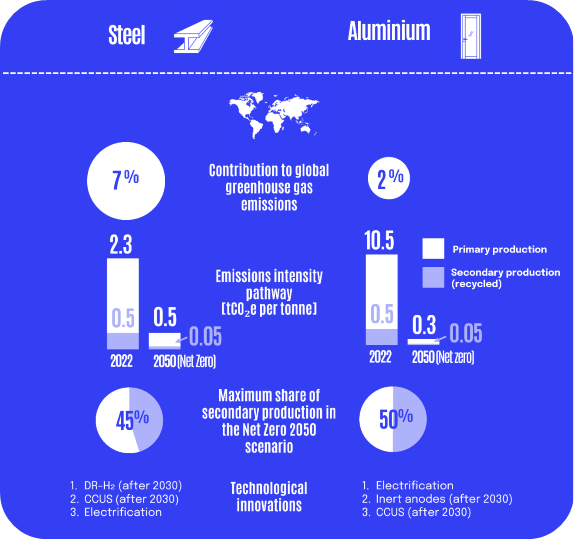
Steel is currently the most widely used construction material, valued for its strength, flexibility, and recyclability. But it is also one of the most carbon-intensive: the steel industry accounts for roughly 7% of global GHG emissions, more than the entire automotive sector.
The reason lies in the dominant production method—the blast furnace—which uses up to 600 kg of metallurgical coal per ton of steel produced, generating approximately 2 t CO₂/t.
By contrast, the electric arc furnace (EAF) route, which relies on scrap recycling, emits 3 to 5 times less CO₂, and up to 30 times less when powered by low-carbon electricity. For example, in Switzerland, Stahl Gerlafingen processes local scrap with emissions below 0.4 t CO₂/t.
Today, this “secondary” route accounts for only one-third of global production but just 15% of sector emissions. It represents the first step toward a Net Zero pathway, which, according to the IEA, requires a 27% emission reduction by 2030 and 90% by 2050.
Aluminum: the hidden face of a “light” metal
Aluminum attracts architects and engineers for its lightness, durability, and corrosion resistance. Yet primary production remains extremely carbon-intensive.
Bauxite mining, refining into alumina, and the Hall-Héroult electrolysis process require enormous amounts of electricity. When sourced from coal, the footprint reaches up to 16 t CO₂/t, compared with around 4 t in hydroelectric-powered regions.
In 2023, the global average remained at 10 t CO₂/t, even though demand is expected to double by 2050.
Recycling is a major lever here as well: it can reduce emissions by 95%, achieving approximately 0.5 t CO₂/t, without significant quality loss.
Around 36% of global production already comes from remelting scrap and offcuts—a rate expected to grow but limited by material availability.
A unique situation in Switzerland
Switzerland produces neither primary steel nor primary aluminum but has an efficient recycling industry and high-value processing industries.
Two electric steel mills—Swiss Steel and Stahl Gerlafingen—produce roughly 700,000 t of steel per year from local scrap. However, national demand exceeds 2 million tons, requiring imports from Germany, France, or Austria.
For aluminum, Switzerland imports raw metal and transforms it into windows, facades, profiles, or automotive components. Recycling is highly efficient (up to 96%), but remelting occurs abroad.
These specificities make Switzerland dependent on international trajectories but also a laboratory for innovation in circularity and traceability.
Recycling: a pillar but not a single solution
Even in the most optimistic scenarios, recycling alone will not suffice.
According to the IEA, steel scrap will only cover about 45% of global needs in 2050, and recycled aluminum about 50%.
Limits stem from the quality of available streams, alloy contamination, and, above all, the time lag: it often takes decades before products on the market today return as usable scrap.
Decarbonization will therefore rely on a combination of levers: material efficiency, reuse, structural lightening, and technological innovation.
Technological innovations: promises and uncertainties
Steel: towards hydrogen production and carbon capture
The most advanced technology today is direct reduction of iron using green hydrogen (DRI-H₂). This process can reduce emissions by up to 95% compared to the coal-based route.
Pilots exist in Europe—Hybrit in Sweden, Salzgitter and ArcelorMittal in Germany—but industrial maturity is not expected before 2030–2035 at best, due to limited green hydrogen and renewable electricity capacities.
Meanwhile, carbon capture and storage (CCUS) is a transitional option, potentially reducing emissions from existing blast furnaces by about 90% without major plant modifications.
However, these technologies involve investment costs 40–70% higher than current methods, and deployment will depend on carbon policies and storage infrastructure.
Aluminum: electrification and technological breakthroughs
The main lever for aluminum lies in decarbonized electricity. Switching to renewable or nuclear electricity already reduces the carbon footprint by a factor of four. Companies like Hydro offer low-impact ranges, such as Hydro REDUXA, with less than 4 t CO₂/t.
The true revolution will come from inert anodes, which replace the carbon anodes used in electrolysis. This would eliminate direct emissions and release only oxygen. The ELYSIS project (Alcoa / Rio Tinto) is pioneering, but large-scale adoption is not expected until the next decade.
Different trajectories but a shared imperative
Despite their differences, steel and aluminum share a common challenge: reducing emissions by factors of 5 to 30, respectively, by 2050 while meeting growing demand.
Achieving these goals requires major industrial advances, responsible purchasing policies, increased utilization of recycled materials, and more efficient construction design.
Looking beyond technology
The transition of these metals will not be purely technological. It will also depend on the ability of stakeholders to cooperate, develop common standards, and create incentives for a circular market.
Architects, engineers, project owners, and suppliers play a crucial role in directing demand toward low-impact materials and promoting transparency on environmental impact data.
At Earth Action, we help organizations navigate this trajectory: analyzing flows, identifying levers, setting credible targets, and implementing the partnerships needed to progress toward Net Zero.
Ready to rethink your low-carbon supply strategy?
Earth Action helps identify priority levers, evaluate technological options, and transform your supply chain into a driver of decarbonization.
📩 contact@e-a.earth
🔗 www.e-a.earth
Sources:
World Economic Forum (WEF, 2024), Aluminium industry net-zero tracker, Steel industry net-zero tracker
World Economic Forum (WEF, 2023), Net-Zero Steel: Strategies for Achieving Decarbonization
International Energy Agency (IEA, 2023), Net Zero Roadmap: A Global Pathway to Keep the 1.5 °C Goal in Reach
International Energy Agency (IEA, 2021), Net Zero by 2050 – A Roadmap for the Global Energy Sector.
International Energy Agency (IEA, 2022), CCUS in Clean Energy Transitions.
SECO / newsd.admin.ch (2023), Commerce extérieur suisse 2023.
Données Douane Suisse Import / Export 2024.