

Authors: Noémie Voirin
Tricky plastics, big unknowns
Plastics are everywhere, but not all microplastics are the same. Tires, paint chips, and synthetic fibers behave differently from the types most studied in oceans and rivers. Zoie Diana, interdisciplinary environmental scientist and PFN Scientific Committee member, focuses on these “tricky microplastics,” investigating their sources, chemical composition, and effects on biota.
“I focus on the wear-and-tear of paints, tires, and fibers. These tricky microplastics behave differently and have distinct impacts, so understanding them is critical to tackling plastic pollution effectively.”
Her research integrates ecology, environmental health, analytical chemistry, and social science to understand these plastics holistically — from source to environmental effect — and explore how science can inform actionable solutions.
Measuring what is nearly invisible
Tracking these microplastics is inherently difficult. Their small size, mobility, and tendency to degrade, combined with limited transparency in industrial waste logistics, make them elusive.
“While much progress has been made in microplastics research, these tricky types require adapting our methods. It’s both a challenge and an opportunity to improve how we capture real-world impacts.”
Zoie stresses that the challenge is both technical and systemic: reducing these plastics is less about logistics and more about changing long-established production and sourcing practices. By understanding how plastics move through environments and supply chains, organizations can identify where interventions will be most effective.
Collaboration that turns insight into action
Because tricky microplastics involve so many sources and pathways, no single researcher or discipline can tackle them alone. Measuring, analyzing, and mitigating these plastics requires cross-sector collaboration.
PFN provides a platform where scientists, industry actors, and policymakers can share data, harmonize methods, and translate insights into actionable strategies. Zoie emphasizes the importance of this collective approach:
“PFN brings people together from different fields and geographies. This collaboration is essential for turning scientific understanding into real-world mitigation.”
Through PFN, organizations can better understand their macro- and microplastic outputs, identify hotspots, and design targeted interventions, ensuring mitigation strategies reflect the full complexity of plastic pollution.
From insight to implementation
Understanding and measuring tricky microplastics is only part of the picture. Zoie highlights that actionable solutions already exist — and that implementing them is key.
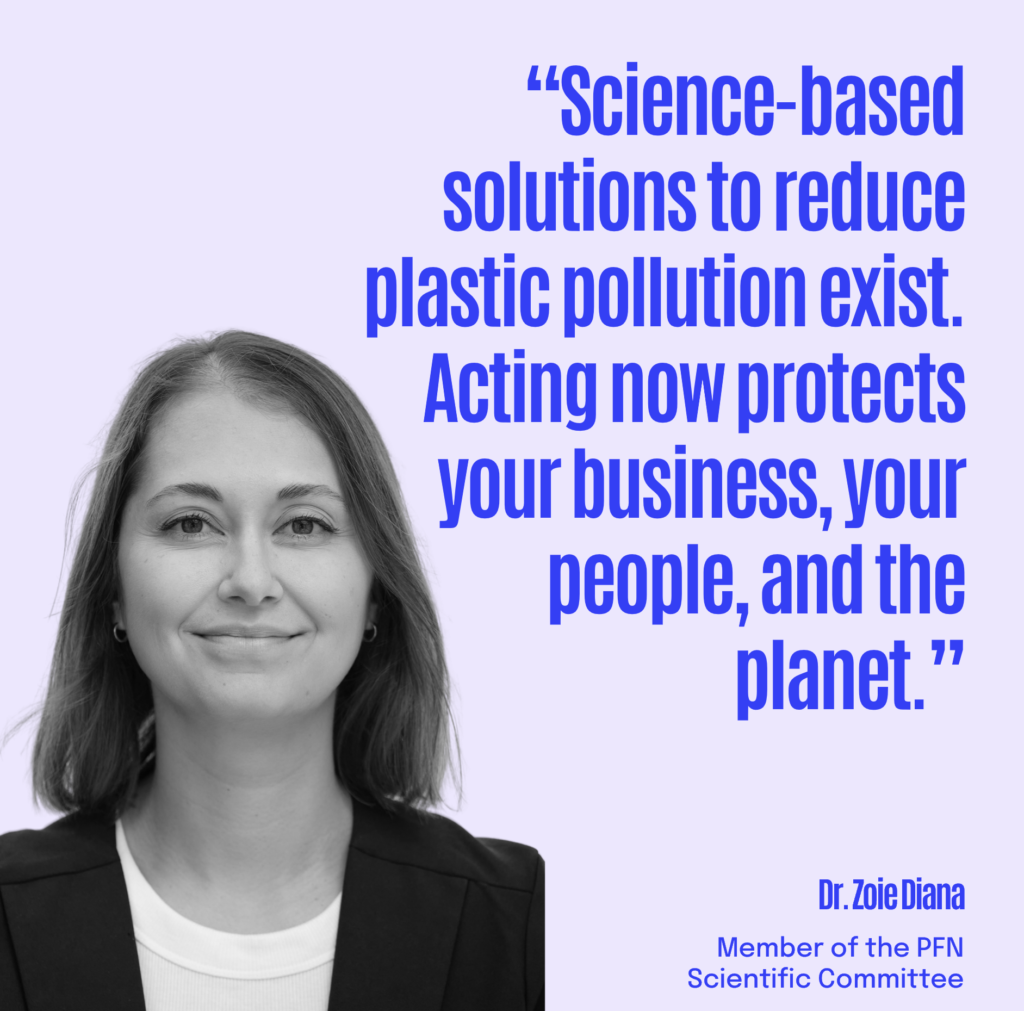
“Science-based solutions to reducing plastic pollution exist. Implementing them now protects your business, people, and the planet.”
Her advice encourages companies to rethink product design, sourcing, and packaging, while guiding policymakers toward systems that prioritize transparency, local production, and circularity. Upstream prevention and reduction remain far more effective than downstream fixes alone..
Staying motivated amid complexity
Working in this field can feel daunting. The scale of plastic pollution is enormous, and progress often seems slow. Yet Zoie draws optimism from the growing community of researchers, practitioners, and citizens engaged in mitigation.
“Seeing so many people committed to reducing plastic pollution is inspiring. Collective effort is what gives me optimism.”
Her perspective underscores that long-term, cross-sector engagement is critical to addressing tricky microplastics — and that science, collaboration, and action are intertwined.
From science to action
Zoie Diana’s work highlights the importance of studying and mitigating “tricky” microplastics. By improving methods, filling data gaps, and fostering collaboration through PFN, her research helps organizations and policymakers move from uncertainty to informed, practical action.
To explore PFN’s tools, datasets, or assess your own plastic footprint, visit plasticfootprint.earth or contact the network at contact@plasticfootprint.earth.
NL summary
Tackling tricky microplastics: insights from Zoie Diana
Plastics are everywhere, but some microplastics — from tires, paints, and fibers — are often overlooked. Zoie Diana, PFN Scientific Committee member, explains why understanding these “tricky microplastics” is crucial for accurate footprinting and effective mitigation. Her work combines method development, data analysis, and cross-sector collaboration to help organizations identify hotspots, design targeted interventions, and act upstream in product design and sourcing. By translating complex science into practical strategies, Zoie’s research empowers businesses and policymakers to reduce plastic pollution with evidence-based, life-cycle-informed approaches.
S’attaquer aux microplastiques complexes : le point de vue de Zoie Diana
Les plastiques sont omniprésents, mais certains microplastiques — issus des pneus, peintures ou fibres — sont souvent négligés. Zoie Diana, membre du comité scientifique de PFN, explique pourquoi comprendre ces « microplastiques complexes » est essentiel pour mesurer correctement les empreintes plastiques et mettre en place des stratégies efficaces. Son travail combine le développement de méthodes, l’analyse de données et la collaboration intersectorielle pour aider les organisations à identifier les points sensibles, concevoir des interventions ciblées et agir en amont dans la conception et l’approvisionnement. Grâce à une traduction claire de la science en stratégies pratiques, sa recherche permet aux entreprises et décideurs de réduire la pollution plastique de manière fondée sur des données.
Pull-out quote :
“Science-based solutions to reducing plastic pollution exist. Acting now protects your business, your people, and the planet”
« Des solutions basées sur la science pour réduire la pollution plastique existent. Agir maintenant protège votre entreprise, vos collaborateurs et la planète. »