

Authors: Romain Bosson
Did you know that the “idle” money sitting in our bank accounts generates far more CO₂ than Switzerland’s entire industrial activity?
We often talk about the carbon footprint of our transportation, our food, or our imports. But there is a massive blind spot: the impact of our financial system.
The money placed in our accounts, funds, or pension schemes is not abstract—it concretely finances factories, infrastructure, or extractive activities, often on the other side of the world.
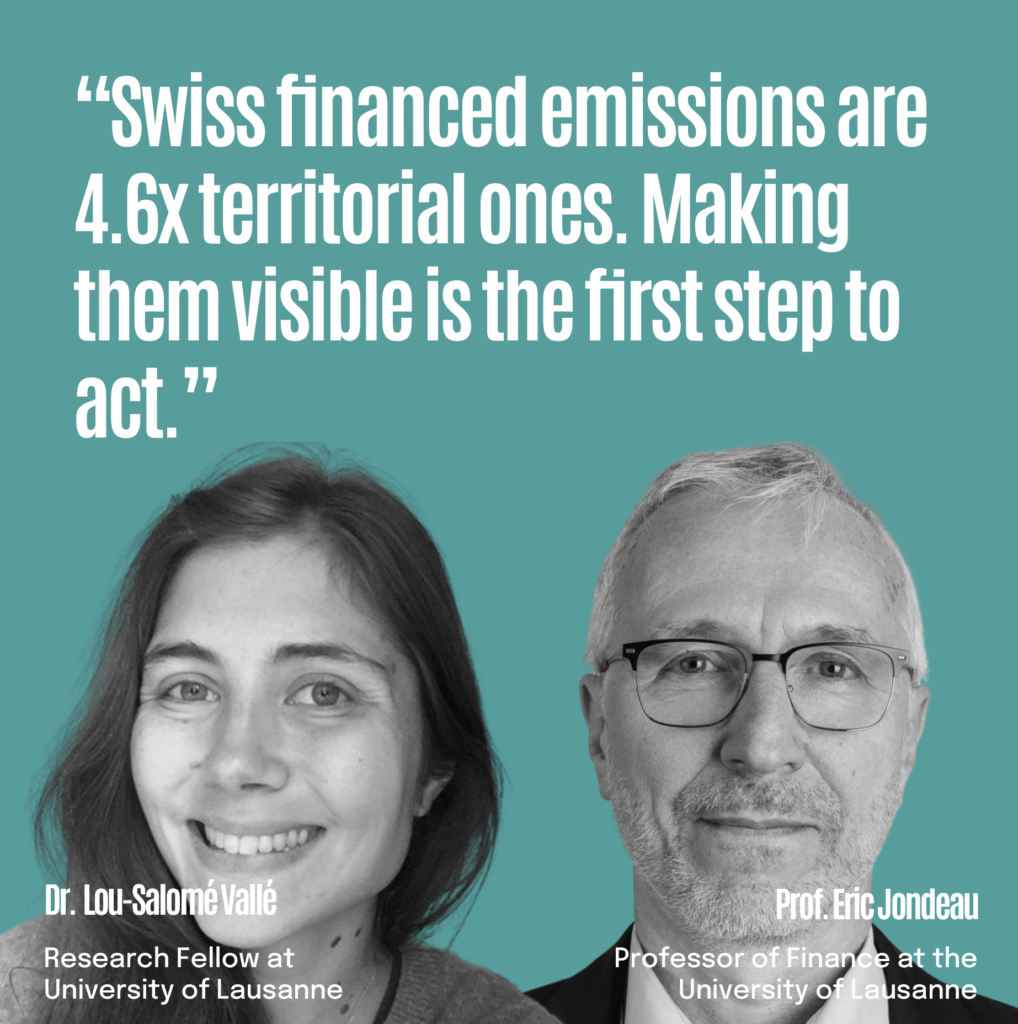
To fill this gap, Lou-Salomé Vallée and Eric Jondeau, researchers at HEC Lausanne, developed an innovative method to quantify these “financed emissions.” Their findings for Switzerland are striking: in 2022, the Swiss financial system “activated” around 193 million tons of CO₂ equivalent—4.6 times the country’s territorial emissions.
In other words, for every ton of CO₂ emitted within Switzerland, its financial system generates nearly five more abroad. We spoke with the authors to better understand their approach.
Key takeaways
- The finding: Switzerland’s financed emissions far exceed its territorial emissions.
- The method: A macroeconomic approach combining national financial accounts, a “look-through” mechanism, and environmental databases.
- The challenge: Making the impact of capital visible to better guide asset allocation.
- The lever: Choosing where and in which sectors to invest has far more impact than trying to “green” existing assets.
Why add finance to existing climate indicators?
Lou-Salomé Vallée & Eric Jondeau : Discussions often focus on territorial emissions (what is produced in the country) or consumption emissions (what is imported). These indicators are essential, but they have a major limitation: they say nothing about the role of the financial system in directing economic activity.
Finance does more than record flows; it allocates capital and enables very concrete productive activities. To fully understand a country’s environmental footprint, we must examine what its financial system makes possible, including abroad.
In highly open economies like Switzerland, this dimension is crucial. These approaches should be seen as complementary: consumption footprints reveal the impact of imports, while financial footprints reveal the impact of capital—highlighting different levers for action.
Why is Switzerland such a revealing case study?
L.-S. V. & E. J. : Switzerland is particularly relevant for two reasons. First, it has highly precise financial accounts from the Swiss National Bank. Second, it is a highly internationalized financial hub, with a significant share of assets invested abroad.
Our results clearly illustrate this: financed emissions reached around 193 MtCO₂e in 2022—4.6 times territorial emissions. This shows that an international financial center can have a disproportionately large environmental footprint compared to its domestic economy.
What is innovative about your method?
L.-S. V. & E. J. : The key innovation lies in combining three elements to provide a coherent, systemic view:
- National financial accounts to identify who is financed and by how much
- A “look-through” mechanism (inspired by Leontief models) to reconstruct intermediation chains
- Global environmental databases (like Exiobase) to link financial flows to real-world impacts (CO₂, water, land use)
This eliminates partial estimates and provides a comprehensive, reproducible measure of finance-driven environmental pressures.
How can we visualize these complex chains?
The financial system can be imagined as a set of “Russian dolls”: money passes through several layers before reaching the real economy.
L.-S. V. & E. J. : his analogy is accurate. Investments rarely go directly to the real economy: households deposit money in banks, banks invest in funds, funds hold bonds, and companies finance industrial activity.
The challenge has been managing these chains:
- Stopping at the first link ignores real impact
- Adding all links without a method leads to double counting
Our approach reconstructs these flows to calculate “effective” exposures. Impacts are distributed proportionally across actors, highlighting shared responsibility along the chain.
How does savings finance emissions abroad?
L.-S. V. & E. J. : The mechanism is direct. An investor holds shares in a Swiss fund, which invests in securities issued by foreign companies or governments. These entities use the capital to produce electricity, extract minerals, or build supply chains.
The investment itself does not emit CO₂—but it enables the activity that does. Our method quantifies this financial causality, linking each franc invested to environmental pressures.
Can this approach be applied at the cantonal level?
L.-S. V. & E. J. : Adding a financial dimension would enrich territorial analyses by identifying emissions enabled by local savings and investments.
While robust at the national level, applying it locally is challenging due to limited data. Partial approaches are possible using data from local actors like cantonal banks or pension funds. Even imperfect, this could open new levers for action.
What actions can policymakers and financial institutions take?
L.-S. V. & E. J. : The first step is measurement—what remains invisible is hard to address.
- For public authorities: dashboards, risk analysis, stress tests integrating climate risks into financial stability
- For financial institutions: asset allocation, counterparty selection, and shareholder engagement
A key finding: much of the footprint comes from the structure of investments, especially geographic exposure. Changing regions or sectors can have more impact than improving internal efficiency.
How can organizations like Earth Action use this?
L.-S. V. & E. J. : These insights can enhance existing assessments by adding a “finance” dimension, helping identify where impacts are concentrated. They also support dialogue between public actors, investors, and companies to better integrate indirect impacts.
Conclusion: a new compass for sustainable finance
Territorial emissions remain essential for energy policy, but they are no longer sufficient to assess environmental responsibility in open economies. Consumption footprints revealed the impact of imports; financial footprints now reveal the impact of capital.
At Earth Action, we believe that making this invisible impact visible is the first step toward truly sustainable finance. Integrating financed emissions into strategies allows action where leverage is greatest.
The next step is to turn these macroeconomic insights into operational tools so that every capital allocation decision fully reflects its environmental reality.