

Authors : Noémie Voirin
The microplastic nobody was looking for
Ship paint is plastic. A ship is painted, repaired and repainted across its working life, and each of those operations is a potential source of microplastic particles. It is a source that only recently began to attract scientific and policy attention, which is roughly when Ginevra Oertel started studying it.
Ginevra Oertel is completing her doctorate in the Ocean Operations and Civil Engineering Department at NTNU Ålesund in Norway. She is a member of the Scientists’ Coalition for an Effective Plastics Treaty and of the Scientific Committee of the Plastic Footprint Network, a group of more than forty organizations convened by Earth Action to agree on a single way of measuring plastic footprints. Her work sits between environmental science, policy and management, and it is aimed at prevention strategies for marine plastic pollution in the maritime sector.
“During my PhD, I investigated the generation of microplastic particles from ship paint throughout the ship life cycle, applying pollution prevention and control principles to identify strategies for involved stakeholders such as shipbuilders, shipowners, regulators, policymakers, and researchers.”
The list of stakeholders in that sentence is the clue to what makes her work unusual. She was not only measuring a source. She was working out who, along a supply chain, is in a position to do anything about it.
Where the data does not exist yet
Before anyone can act, somebody has to measure, and that is where she locates the binding constraint. The problem is not only that the numbers are uncertain. For industrial microplastics, there is often no established way to obtain them at all.
“I think the biggest challenge we have is related to data collection: how and where to collect data and the generation of data itself, which is needed to measure plastic footprints. When it comes to microplastic emissions, industrial guidelines and capacities are missing to help companies collect and interpret data.”
That gap has an awkward property. It cannot be closed once, for everything.
“There is also the need for the development of many individual methodologies to collect such data, as microplastics are heterogeneous particles and are bound to products and sectors. This may take some time, given the complexity of the particles.”
Particles shed by a ship’s coating and particles shed by fishing gear behave differently and come from different operations, so each needs its own protocol. For a company, the practical consequence is that a microplastic source can be real, material and entirely absent from its reporting, simply because nobody has yet written the method for measuring it.
From research to something an organisation can use
This is the part of the network’s work she describes as the reason she joined it. A member of the PFN approached her as an academic partner, and the committee invitation followed from her doctoral work on a source few people were looking at.
“What excites me most about this role is the opportunity to contribute to the evidence-based development and scientific validation of methodologies for measuring individual sources of plastic footprints.”
“I find it particularly rewarding to translate scientific research into practical tools and modules that can be applied by organisations beyond academia, enabling evidence-based decision-making and supporting more effective plastic pollution management.”
Translation is the operative word. A validated method that stays inside a research group changes nothing about what a shipyard does on a Tuesday morning.
Making it somebody’s job
Her next step concerns where microplastic emissions sit inside a company’s own structure.
“I am mostly excited about the continuation of my PhD work by further developing managerial frameworks for different industrial sectors, addressing the integration of microplastic emission management into diverse company relevant managerial fields or strategies, such as risk management, EHS management or their sustainability strategy.”
That is a more practical ambition than it first appears. Risk management, environment, health and safety, and sustainability strategy are functions that already exist in industrial companies, with owners, budgets, procedures and audit trails. An emission attached to one of them acquires a procedure and someone answerable for it. An emission attached to none of them does not. Her work is about making that attachment explicit.
She is already working in a second maritime sector. Through the Blue Circular Nets project, funded by Interreg and the Northern Periphery and Arctic programme, she works on fishing gear pollution in the Nordic Seas, on the barriers to recycling gear and on preventing the pollution that comes from abandoned, lost and discarded fishing equipment. Different sector, different particles, same question: who can act, and through which procedure.
Prevented by design
Asked for one piece of advice for businesses and policymakers, she points further upstream than measurement or management.
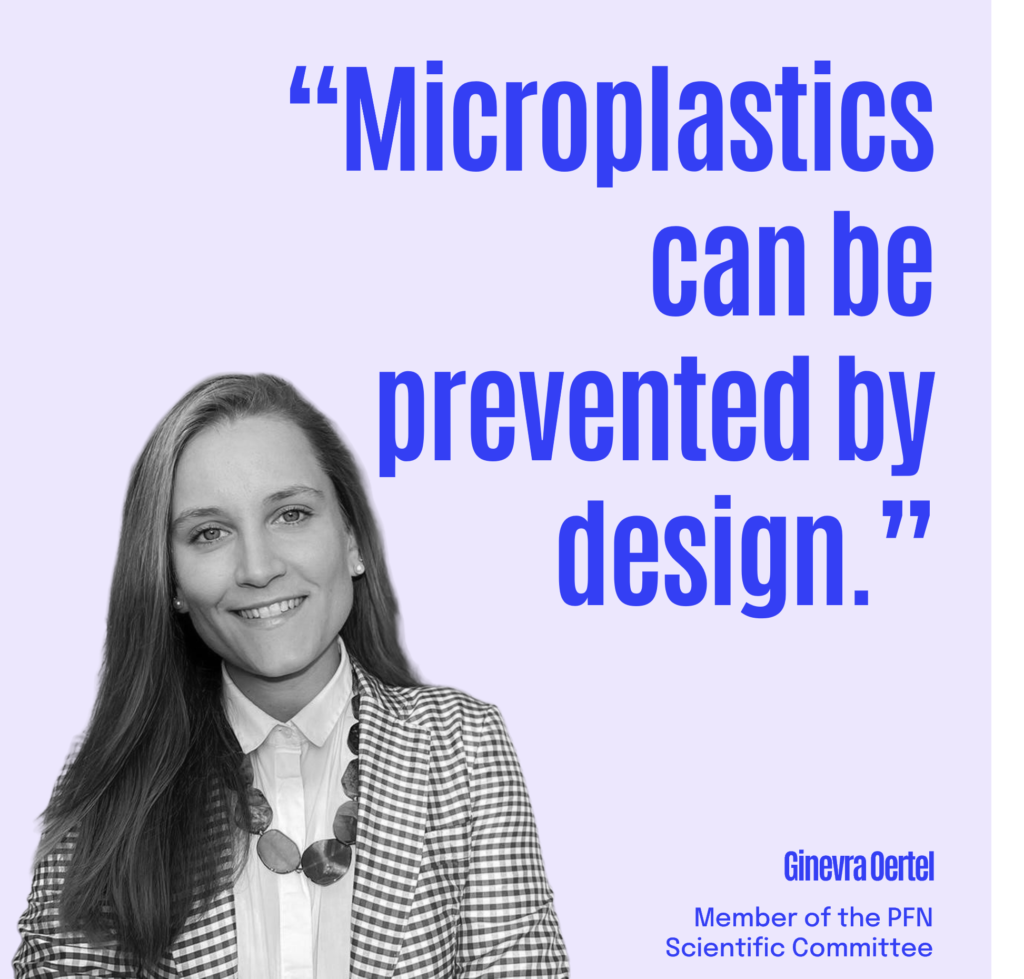
“I would emphasise the importance of the product design stage, where microplastics can be prevented by design. Addressing the issue at its source minimises the need for subsequent control and management measures, making prevention the most effective strategy for reducing microplastic pollution.”
The sequencing matters for cost. A source that can be designed out needs no sampling protocol, no monitoring budget and no control measure later on. Where design cannot remove it, the measurement and management problems described above remain, and that is what the rest of her research addresses.
Into the managerial field
What she is ultimately proposing is a change of discipline for the subject.
“Ultimately, my goal is to bring the topic of microplastic pollution into the managerial field by providing organisations with practical managerial solutions to control and prevent microplastic emissions from industry’s production and operations.”
Microplastic pollution has been a question for chemists, ecologists and, more recently, for regulators. Treating it as a management question as well is what turns a measured source into a decision somebody is accountable for.
To explore PFN’s tools, datasets, or assess your own plastic footprint, visit plasticfootprint.earth or contact the network at contact@plasticfootprint.earth.