

Author : Noémie Voirin
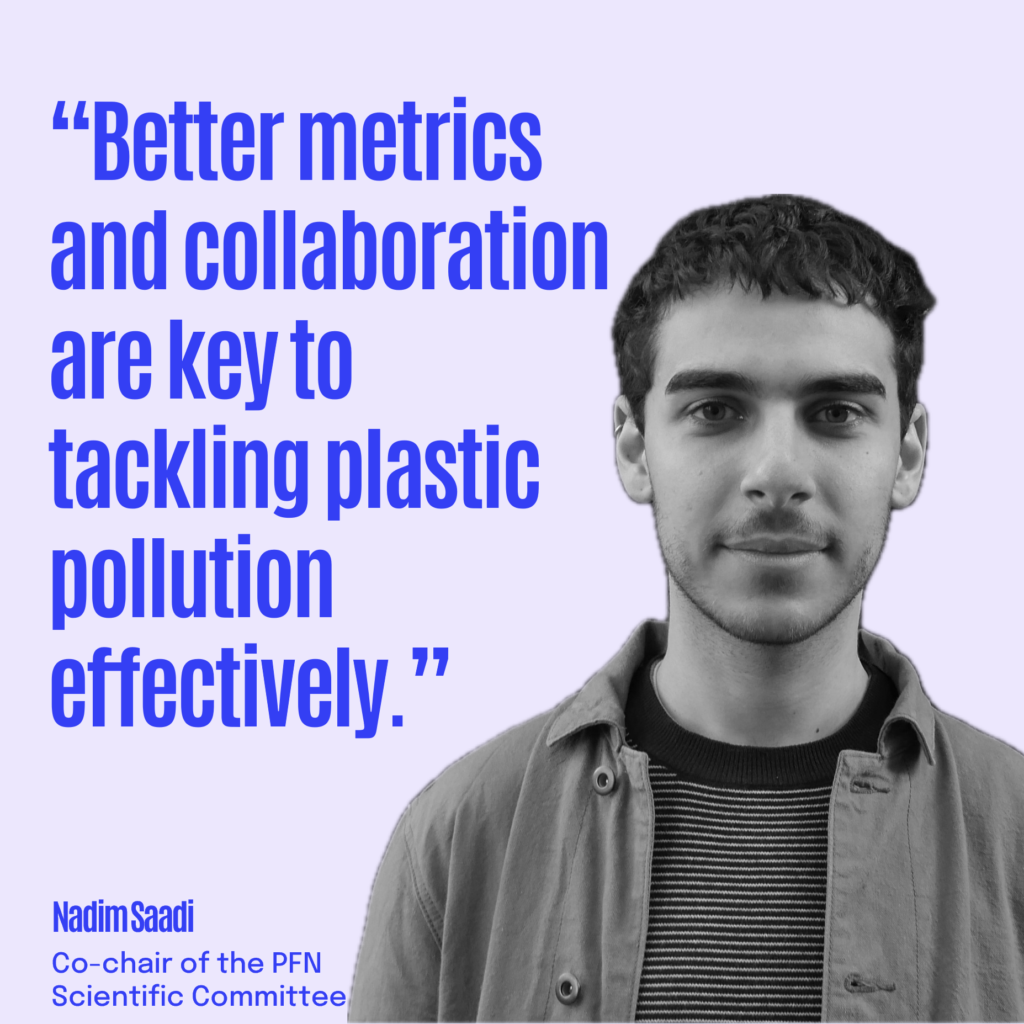
The Plastic Footprint Network (PFN) brings together scientists, companies, and policymakers to measure and reduce the impacts of plastics. Nadim Saadi, recently appointed co-chair of the PFN Scientific Committee, focuses on understanding the often-overlooked effects of microplastics and developing methods that make plastic footprinting both rigorous and actionable.
We spoke with Nadim about his research, the challenges of measuring plastic footprints, and what excites him most about the future of this field.
Measuring the invisible: microplastics in LCA
Nadim’s research is centered on integrating microplastic impacts into Life Cycle Assessment (LCA), a key tool for evaluating environmental performance. Traditional LCA methods do not fully account for all consequences of plastic emissions, which can lead to misleading comparisons between plastics and alternatives.
“The metrics I am developing aim to allow for a more accurate comparison between plastics and their alternatives, as LCA does not currently consider all the impacts that plastic emissions have across the plastic lifecycle.”
For example, his work has led him to develop specific expertise in textiles and the environmental impacts of leaked microfibers, allowing cellulose-based and synthetic textiles to be compared in a fair and consistent way.
This focus on microplastics naturally led Nadim to engage more deeply with PFN, where he could apply his research in a collaborative, cross-sector context.
From working group member to co-chair: Nadim’s PFN journey
Nadim initially joined PFN as a member of the textile microfibers working group. This gave him a chance to contribute to the network while gaining knowledge about microfiber emissions. The following year, he co-led a working group on impact assessment, and a year later, he joined the scientific committee, stepping into his current role as co-chair.
What excites him most about PFN is seeing growth and new opportunities through the network. He enjoys watching actors from academia, industry, and policymakers come together to gain and generate new knowledge on the different topics addressed, making collaboration both productive and inspiring.
The challenge of measuring plastic footprints
A major hurdle in reducing plastic footprints is the lack of consistent data and metrics. Without standardized methods, it can be difficult—or even impossible—to quantify impacts accurately and track improvements.
“It is hard or even impossible to decrease one’s plastic footprint when it could be quantified in many ways, or simply can’t for part of the impacts.”
While these gaps make the work challenging, they also make it intellectually stimulating. Nadim emphasizes that plastics are just one part of a larger set of environmental and human health challenges, underscoring the complexity of the problem.
PFN’s role in turning challenges into solutions
These challenges highlight why PFN’s collaborative platform is so valuable. By bringing together experts from multiple sectors, the network helps align methods, clarify definitions, and identify where consensus is possible.
This collaborative approach ensures that plastic footprinting is both scientifically rigorous and practical, guiding organizations to focus efforts where they will have the greatest impact.
“The network plays an important role in harmonizing data and advancing solutions, and also helps clarify the limits of existing tools, which is essential for making plastic footprinting useful in decision-making.”
Exploring the future: ecosystem services and human health
Looking ahead, Nadim is excited about research examining how plastics affect ecosystem services, including carbon sequestration, nutrient cycling, and water quality. He is also following emerging results on human health impacts, which could provide insights into the broader consequences of plastic pollution.
“This will allow us to start linking plastic pollution to broader Earth system functioning.”
By connecting plastic footprints to wider environmental and societal outcomes, Nadim hopes to provide a more holistic understanding of the issue.
Hope and realism: tackling plastic pollution step by step
Nadim is candid about the scale of plastic pollution: solutions will not come overnight. Yet he finds optimism in the expertise being developed by scientists and networks like PFN.
“We have come a long way from early experiments to the data and models that we are generating now, and I am optimistic that all the knowledge gained will eventually be useful, not only for plastics, but for many emerging challenges.”
Through continued collaboration and rigorous research, he believes today’s insights will lay the groundwork for future action.
Learn more or assess your plastic footprint
As Nadim’s work highlights, better metrics and cross-sector collaboration are essential to addressing plastic pollution. To explore PFN’s modules or assess your own plastic footprint, visit https://www.plasticfootprint.earth/ or contact us at contact@plasticfootprint.earth