
Authors : Virginie Galdemar et Caroline Daumas
The sustainability of an organization is not measured solely by its environmental or social impact: it also relies on how its finances are managed and governed — choice of partners, process transparency, governance, strategic steering.
In a dialogue, Caroline Daumas, Chartered Accountant and founder of the fiduciary Rouge·Kaki, and Virginie Galdemar, Administrative and Finance Manager at Earth Action, explain how an accounting collaboration can become a lever for organizational transformation.
Virginie (EA Earth Action SA): When we were looking for a fiduciary, as with all our service providers, we asked ourselves a simple question: “Will our partners help us move forward technically in the right direction, and are they aligned with our values?”
Caroline (Rouge·Kaki): When I created Rouge Kaki, before talking about methods or tools, I asked myself what our profession is truly for and what role a fiduciary can play in the transition. Accounting is not a mere technical service; it has a concrete impact on how an organization directs its choices, prioritizes its resources, and embodies its values.
If accounting is not thoughtfully designed, it can weaken a company’s mission. If it is aligned, it can reinforce it. That is where our commitment lies: putting our technical competencies at the service of coherent governance and strategy.
A relationship that goes beyond the usual framework
Virginie: What surprised me is that our relationship was never limited to “doing the books.” From the beginning, we worked together to lay the foundations of a structured finance function, with a clear objective: to have readable accounting that can be used by leadership and serve the strategy.
We have been collaborating since 2021, and over time I learned to analyze figures, understand mechanisms, steer operations, and clarify the boundaries between our “for profit” and “non profit” components — an articulation that lies at the heart of our impact business model. This growing expertise, supported by field experience and your guidance, has shifted my role toward an internal financial leadership position, capable of providing analyses of actuals and forecasts to support key decisions.
Caroline: That is the core of our profession. We are often mistaken for number producers, but what truly interests us is the purpose: compiling information, understanding results, and giving them meaning. We help our clients gain autonomy, depending on what they can invest — their skills, their time, their energy. We move forward with them, not in their place, supporting the development of their projects with a long-term vision but at a pace that suits them. Depending on the size of the team, we occasionally take on delegation assignments, but that is not the core of our work.
Numbers only have value if they help steer something and open new perspectives.
What surprised me was Virginie’s ability to integrate all accounting concepts and even implement effective performance indicators to monitor their activities. Do you remember how you started?
Transparency: a tool for alignment
Virginie: Oh yes, very well! We improved year after year, and my “accounting” function had to evolve with the company’s growth. Little by little, we set up very rigorous processes and structured dashboards: today, every financial flow is documented, every operation justified, every accounting decision explained. This discipline creates common ground — a shared language that makes the accounts readable, communicable, and understandable for all stakeholders.
This operational transparency goes beyond compliance: it structures governance, facilitates exchanges, secures processes, and enables the organization to manage its activity with clarity and confidence. It has become a common language.
Caroline: Exactly. Seen this way, transparency is not about control — it is about clarity and trust. It secures flows, eases discussions, and enables teams to understand what is happening rather than endure it.
How has the structuring of your accounting concretely helped you at EA?
Accounting as a compass
Virginie: What fundamentally changed for us is that we now consider accounting — and more broadly financial monitoring, including analytical accounting, budgeting, and cash-flow planning — as a genuine decision-making tool.
At EA Earth Action SA, accounting is no longer a simple administrative exercise or a periodic check-in. It has become a true compass for steering: precise cost tracking by activity, fine-grained margin understanding, automated reconciliations, consolidated reading of commitments… Each tool and process strengthens leadership’s ability to decide, adjust priorities, and invest wisely.
This shift from compliance to strategy is at the heart of what we call sustainable finance. It is not only about reporting, but about guiding decisions: securing organizational structure, directing investments toward models aligned with our values, and informing each choice with a clear and responsible reading.
We no longer just keep accounting up to date; we have a full steering system.
Caroline: Exactly, and that is where sustainable finance truly makes sense: not just reporting, but guiding, steering resources toward coherent models, providing visibility, and supporting the mission. Still, financial indicators alone are no longer enough. To steer a mission-driven organization, we must also integrate extra-financial indicators: environmental impact, social contribution, quality of externalities.
Otherwise, we risk optimizing numbers without measuring what truly matters — missing the mission we set for ourselves. The challenge is ensuring that steering supports the mission across all its dimensions — economic, ecological, and social.
The human factor
Virginie: At the same time, I don’t believe reporting solves everything. The values embodied by the company, its concrete actions, the clients it chooses to work with or not, the profile of its team members — all of this is essential. I used to think the solution would be the tool.
In reality, the key factor, in my view, is people: competence, autonomy, and engagement transform tools and processes into true strategic levers.
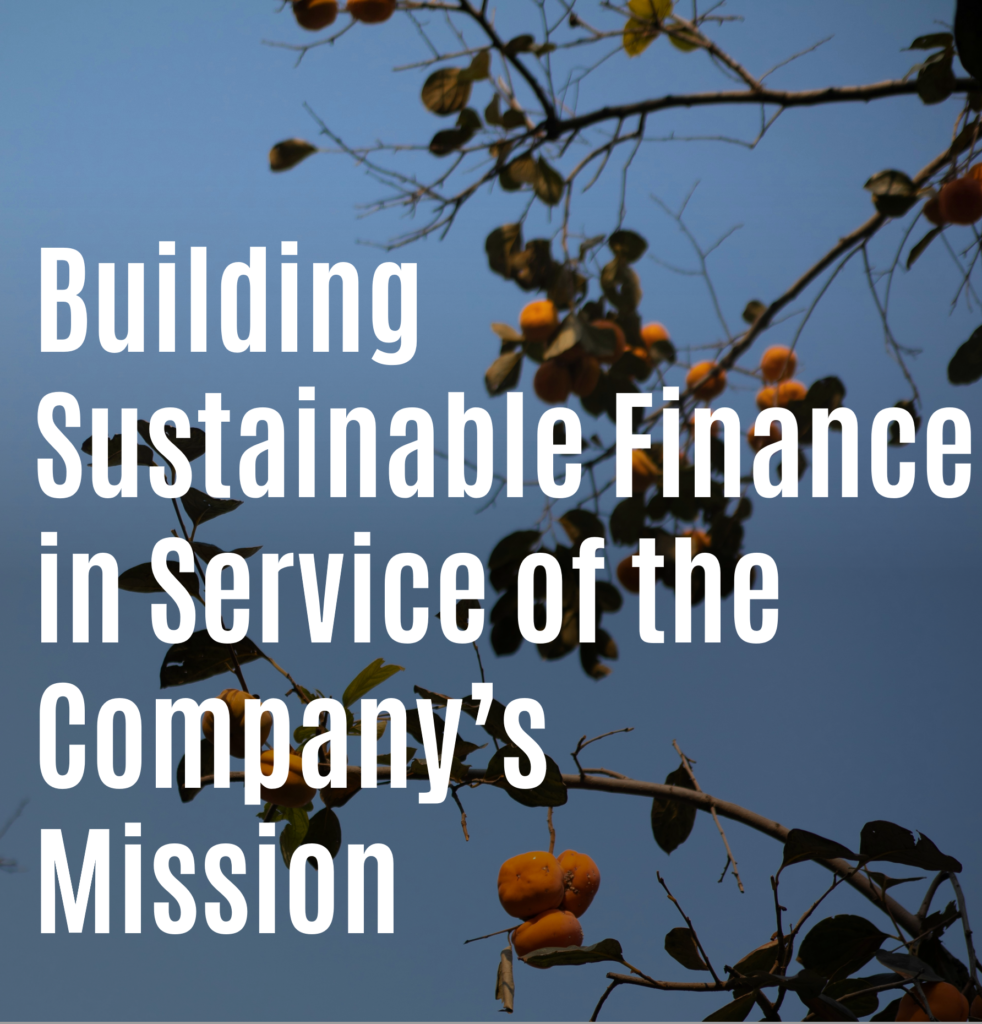
I believe you are also a very committed team at Rouge Kaki, aren’t you? Isn’t planting a persimmon orchard an example of the necessary coherence between your actions and your impact?
Caroline: Yes. Absolutely. What drives us is the challenge and meaning behind what we do: mission-driven projects, complex questions, technical issues that force us to think, test, and improve. Our teams enjoy being challenged, whether within mandates or through their personal projects.
This is also why our team is made up mainly of experts in their fields, working part-time by choice, with organizational freedom that gives us time for our personal projects — like planting fruit trees, in my case.
Conclusion
Caroline: We observe daily among our clients — whether dealing with growth, frugality, innovation, or impact — that the finance function plays a determining role: it guides decisions, structures priorities, and gives strategic choices their meaning.
When grounded in rigor, vision, and human engagement, it becomes much more than a support function: it becomes a lever capable of accompanying all the trajectories an organization chooses to pursue. I am very happy and proud that our clients share this vision, and it is the richness of our exchanges that motivates us every day at Rouge Kaki.
Virginie: Every stakeholder (bank, pension fund, or accounting partner) we collaborate with is evaluated not only on technical expertise, but also on their capacity to move in the same direction as we do: aligned with our values of frugality, respect for planetary boundaries, and awareness of the carbon footprint of their activities. Every opportunity to get closer to our ambitions matters, given the scale of the challenge and complexity of the issues. These strategic partnerships thus become concrete levers for structuring and securing our finances while remaining true to our mission.
We have one last question for you, dear reader: How do you use finance to support your impact-driven mission, and what place do you give it in your organization’s trajectory?