

Author: Noémie Voirin
Turning plastic flows into decision-relevant insights
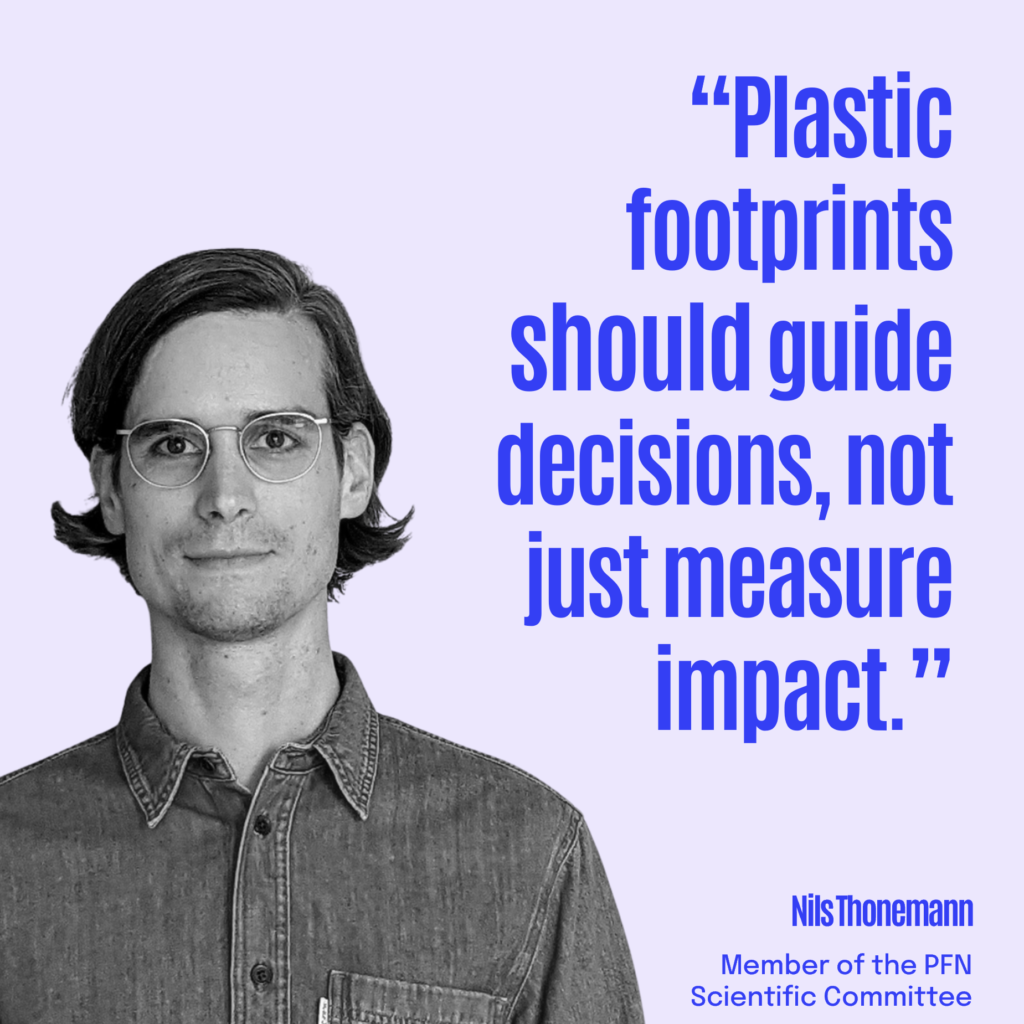
Plastics are used across countless products and industries, yet understanding their full environmental consequences remains complex. Nils Thonemann, Assistant Professor at Leiden University and member of the PFN Scientific Committee, focuses on how environmental impacts from plastics are quantified and translated into decision-relevant information.
“My work focuses on how environmental impacts are quantified across value chains and translated into decision‑relevant information, with a particular focus on plastics and plastic pollution. Part of my research focuses on improving how environmental impacts induced by plastic pollution, especially on land, are represented in LCAs.”
Nils aims to bridge the gap between inventory data in LCA databases and impact assessment methods, striving for plastic footprint metrics that are both transparent and consistent within established LCA frameworks.
Beyond mass: linking plastics to real impacts
A central difficulty in plastic footprinting lies in linking plastic use to actual environmental outcomes. While material flows can often be measured, translating them into spatially and context-specific impacts — particularly for terrestrial ecosystems — remains methodologically challenging.
“A tricky question is how plastic footprints can move beyond mass‑based indicators and better reflect differences in fate, exposure, and impact, while remaining transparent about uncertainty and assumptions.”
This challenge is compounded by the diversity of plastics and their environmental behaviors, meaning that robust comparisons require careful life-cycle thinking rather than relying solely on simple mass-based metrics.
PFN: bridging methodology and action
PFN plays a key role in embedding life-cycle thinking into plastic footprinting. By connecting researchers, method developers, and practitioners, the network strengthens the scientific foundations of footprint metrics while ensuring they remain practical for real-world decision-making.
“PFN can facilitate dialogue between method developers, researchers, and practitioners, helping to improve how plastic pollution impacts are represented and interpreted in practice.”
Through this collaborative approach, PFN encourages more systemic strategies that account for the full life cycle of plastics.
Integrating plastic impacts into life-cycle thinking
Nils is particularly focused on expanding how plastic pollution impacts are incorporated into life-cycle impact assessment for land-based environments, where current methodologies are limited. He is also interested in exploring interactions between plastic footprint metrics and other LCA-based indicators, such as climate or toxicity impacts.
“More broadly, I am keen to explore how plastic footprint metrics interact with other LCA-based indicators, and how trade‑offs between different environmental objectives can be handled more coherently in decision‑making.”
Better integration will allow companies and policymakers to identify hotspots, understand trade-offs, and prioritize interventions effectively across value chains.
Why life-cycle thinking keeps us optimistic
Despite the scale of plastic pollution, Nils sees reason for optimism. The growing recognition that plastic must be addressed across its entire life cycle — not just as a waste management issue — is driving methodological improvements and more credible application of footprint tools.
“I see increasing openness, both in research and practice, to acknowledging uncertainty and methodological limitations, which is essential for improving impact assessment methods and for making more credible use of footprint tools.”
This life-cycle perspective, combined with rigorous analysis, helps guide meaningful action rather than quick fixes.
Using footprints to guide smarter choices
For Nils, plastic footprints are most valuable as starting points for deeper, life-cycle-informed analysis rather than definitive impact scores.
“Footprints help identify hotspots and guide questions about where interventions are most effective across the value chain. For businesses, this means focusing on reduction and design choices informed by LCA insights. For policymakers, it means supporting approaches that account for full life-cycle impacts rather than shifting burdens between stages or regions.”
By using footprints in this way, organizations can take more systemic, effective action to reduce plastic impacts.
From metrics to actionable strategies
Through his work with PFN, Nils is helping ensure that plastic footprinting remains scientifically grounded and practically useful. By combining improved metrics with life-cycle thinking, businesses and policymakers can better understand plastic impacts and prioritize interventions where they matter most.
To explore PFN’s tools, datasets, or assess your own plastic footprint, visit plasticfootprint.earth or contact the network at contact@plasticfootprint.earth.