

Author: Noémie Voirin
The question a footprint does not answer
A plastic footprint tells an organization how much. It does not tell it whether that amount is compatible with anything in particular. Measured against last year, a number can fall. Measured against what the environment can actually absorb, it has no reference point at all.
That second comparison is where Ricardo Rebolledo-Leiva works. He is an assistant professor in the Department of Computing and Industries at Universidad Católica del Maule in Talca, Chile, part of the Circular and Sustainable Engineering Systems group, Associate Editor of the Elsevier journal Cleaner and Circular Bioeconomy, and Principal Investigator of NbS-Waterry project and Director of the MAP-BioRUB project, both funded by ANID (Chile). He also sits on the Scientific Committee of the Plastic Footprint Network, a group of more than forty organizations convened by Earth Action to agree on a single way of measuring plastic footprints.
“My research focuses on the development of quantitative sustainability assessment methods for circular and bio-based systems. I am particularly interested in developing and applying methodologies that support decision-making by quantifying the environmental performance of products, industrial systems, and emerging technologies.”
More recently his work has moved into a younger branch of the discipline, which he defines in one line.
“More recently, my work has expanded towards Absolute Environmental Sustainability Assessment (AESA), which evaluates whether industrial systems operate within planetary boundaries.”
Relative targets and absolute limits
Most corporate environmental targets are relative. Less than last year, less than a baseline, less than a comparable competitor. An absolute assessment asks something else: whether the system sits inside a defined environmental limit, the planetary boundaries that mark what he calls the Earth’s safe operating space. An organization can improve on every relative measure it reports and still be outside that space.
“I believe the next challenge is moving beyond measuring how much impact plastics generate to understanding how those impacts could remain and/or return within the Earth’s safe operating space.”
“Integrating plastic footprint methodologies with Absolute Environmental Sustainability Assessment could provide a much more meaningful basis for decision-making and policy target setting.”
The practical difference is what a target means. A relative target is met by moving in the right direction. An absolute one is met or missed, and the distance to it does not depend on where the organization happened to start.
Why one indicator cannot carry the decision
Before a footprint can be read against a limit, it has to be read correctly on its own terms, and he is direct about where that goes wrong.
“Plastic footprint, and particularly for those bio-based alternatives, should not be considered as a standalone sustainability indicator. It should be complemented with life cycle-based indicators such as eutrophication, water consumption, biodiversity, land use, and other environmental impact categories to avoid burden shifting and support more holistic decision-making.”
Bio-based materials are the case he keeps returning to, and the reason is arithmetical rather than ideological. Growing a feedstock consumes water, land and nutrients, so a bio-based alternative can perform well on plastic leakage and poorly on categories a plastic footprint never examines. Assessing it on one axis produces an answer that is accurate and incomplete at the same time.
Comparable, or not worth comparing
A second condition has to hold before any of this works. A footprint is only informative next to another footprint, which requires everyone to have measured the same way.
“Another challenge is ensuring methodological consistency so that plastic footprints are comparable across products, organizations, and regions.”
That is the work he assigns to the network, described in terms of consensus rather than promotion.
“I believe the Plastic Footprint Network can play a relevant role in building scientific consensus around plastic footprint methodologies while fostering collaboration between academia, industry, governments, and other stakeholders. By promoting transparent, harmonized, and science-based approaches, the network can help ensure that environmental impact assessments become reliable tools to support decision-making and policy development.”
“Rather than promoting a single metric, the Network can help develop comprehensive assessment frameworks that capture environmental trade-offs and guide decisions based on the overall sustainability performance of products and systems.”
The next generation of tools
Put those pieces together and the research question he is most interested in follows on its own.
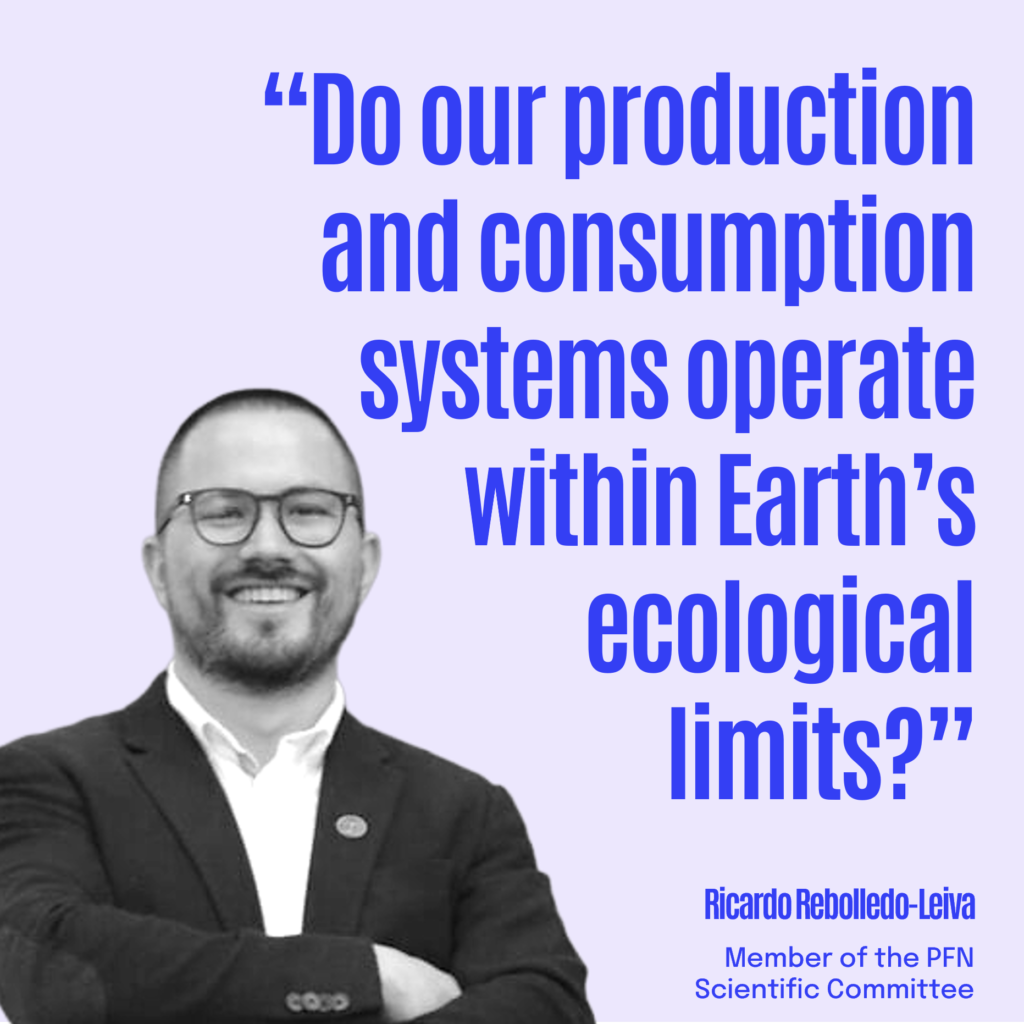
“The next generation of assessment tools should answer a more ambitious question: Do our production and consumption systems operate within Earth’s ecological limits? And how can circular and bio-based systems avoid exceeding them?”
The second half of that question is the one with commercial consequences. Circular and bio-based systems are where a great deal of corporate investment is currently going, and the assessment tools that would confirm whether they stay inside the limits are still being built.
Why he stays optimistic
His optimism rests on capability rather than on sentiment.
“We now have better scientific tools, better data, and increasing awareness of the urgency of the problem. At the same time, innovation in materials, recycling technologies, product design, and circular business models continues to advance rapidly.”
The condition he attaches is collaboration across disciplines and sectors, which is also the reason he gives for joining the network in the first place.
Evidence before assumption
Asked for one piece of advice for businesses and policymakers, he starts with method rather than with material.
“My advice would be to prioritize decisions based on robust scientific evidence rather than assumptions. Plastic should not be viewed simply as a material to eliminate, but as part of a broader system that requires life cycle thinking.”
In practice that means asking what a reduction claim was measured against and what it left out. It also means accepting that the reference point may have to move.
“Success should not only be measured by reducing plastic use, but by ensuring that our production and consumption systems operate within the Earth’s safe operating limits.”
To explore PFN’s tools, datasets, or assess your own plastic footprint, visit plasticfootprint.earth or contact the network at contact@plasticfootprint.earth.