

Author : Noémie Voirin
Seeing the unseen in everyday plastics
Plastics are everywhere: in the clothes we wear, the shoes we put on, the cosmetics and hygiene products we use, and the packaging that surrounds them. Yet much of their environmental impact remains invisible — particularly the role of additives and chemical treatments.
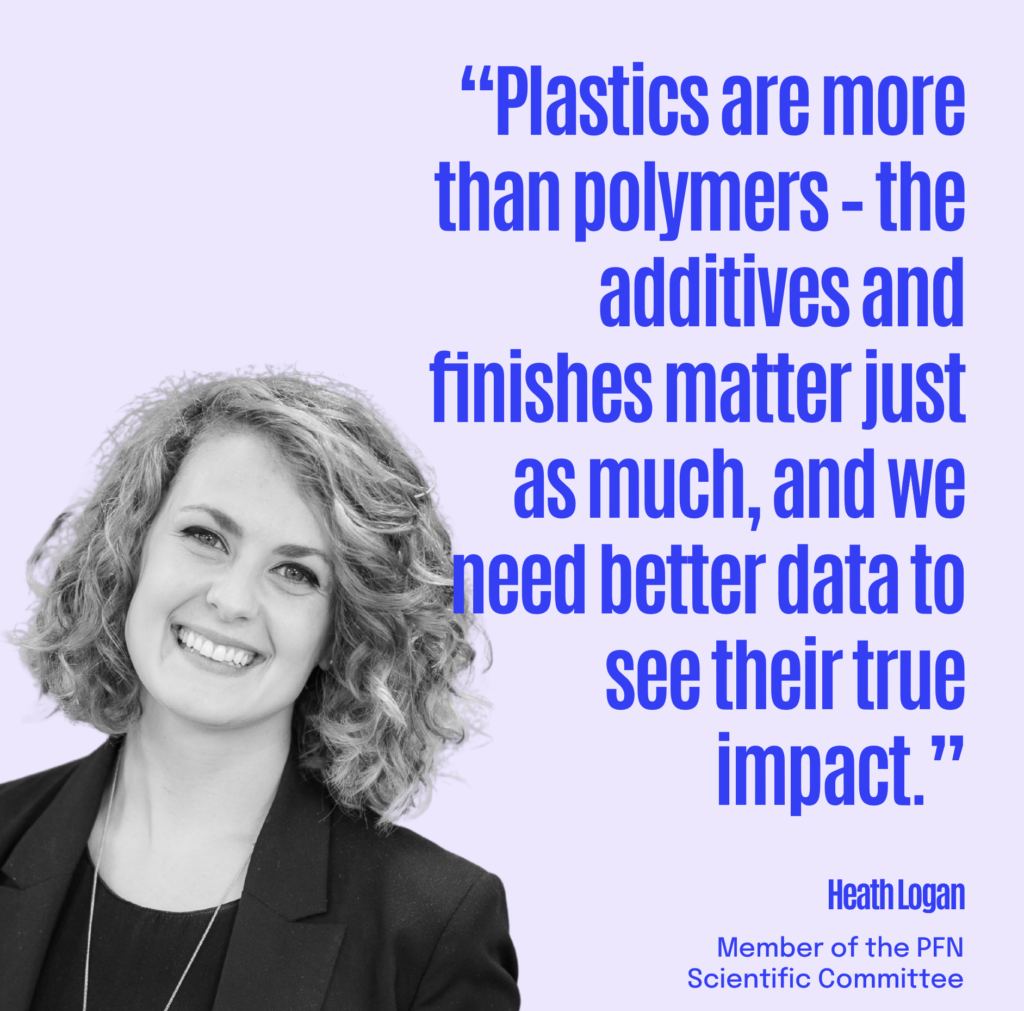
Heath Logan, a member of the PFN Scientific Committee, works to bring these hidden impacts to light. Her research in life cycle assessment (LCA) combines design, materials science, and environmental analysis to give companies, recyclers, and policymakers the tools they need to manage and reduce environmental impacts.
“I focus on textiles, footwear, cosmetics, and hygiene products — including their packaging. Essentially, I bring together design, materials science, and environmental assessment to help companies, waste managers, and recyclers improve communication and plan for better management, mitigation, and prevention of environmental impacts from our daily essentials.”
By providing detailed datasets, Heath helps organizations see beyond the polymer itself and understand the chemicals and materials that contribute to a product’s overall footprint.
The challenge: beyond the polymer
One of the biggest challenges in plastic footprinting is that most assessments focus only on the polymer. Additives and chemical treatments, which give plastics functionality, durability, and performance, are often invisible in standard environmental analyses.
“Additives play a vital role in plastics, yet we have very little data on their use, effects, or emissions. Without this information, it’s incredibly difficult to ensure robust analyses or compare plastics to other materials — especially in products with high additive concentrations.”
These gaps make it challenging to reduce footprints effectively. A plastic finish on a textile, or a chemical treatment on a hygiene product, may be critical for performance — yet invisible in assessments. Without considering these factors, comparisons can be misleading and mitigation strategies incomplete.
Collaboration in action: PFN’s role
Addressing these gaps requires collaboration — and that’s where PFN comes in. Heath joined the network to help strengthen the scientific basis for plastic footprinting. PFN’s open datasets on polymers and microplastics have already advanced the field, and Heath sees a major opportunity in including additives and treatments.
“PFN has already moved the field forward with open-source datasets. The next big opportunity is expanding this work to cover the additives and treatments used in so many products. Including these pieces will make our assessments far more accurate and useful.”
Through PFN’s collaboration, experts from academia, industry, and policymakers can now share data in ways that make footprinting actionable across sectors.
Explore the datasets and tools on plasticfootprint.earth to see how the network is making footprinting more accurate and usable.
Mapping complexity in textiles and footwear
Textiles and footwear are particularly complex. Plastics appear in multiple forms — fibers, coatings, finishes, hybrid materials, and packaging. Heath is focused on improving data in these categories to allow fairer comparisons and more informed decision-making.
“Plastics show up in so many ways in textiles and footwear. Finishes, fibers, hybrid materials —
all of these affect the footprint. Getting better information on this will help us compare
materials more fairly and understand the true impacts of what we wear.”
Better datasets will help companies design products with reduced environmental impact, improve recycling strategies, and prioritize mitigation where it matters most.
Transparency as the foundation for action
Heath emphasizes that transparency is critical. Knowing what goes into plastics allows businesses, designers, and regulators to act effectively.
“Manufacturers should disclose the additives and finishes they use, not just the polymer. Designers and policymakers need this information to make safe, sustainable, and effective decisions. Labels like ‘PP’ or ‘LDPE’ alone don’t tell us enough about impacts or recycling potential.”
Clear disclosure supports better product design, improved recycling, and informed policymaking — all essential steps to reducing plastic pollution.
Building a complete picture
Through her work with PFN, Heath is helping create a more complete and actionable picture of plastic impacts. By combining additive data with traditional polymer metrics, decision-makers can better reduce pollution and design products with circularity in mind.
“Bringing additives and detailed material data into the conversation allows us to understand the real footprint of everyday products and develop better strategies for mitigation and circularity.”
To explore PFN’s tools, datasets, or assess your own plastic footprint, visit plasticfootprint.earth or contact the network at contact@plasticfootprint.earth.