
Authors: Julien Boucher, Sarah Perreard & Arnaud Dauriat
In December 2024, we wrote publicly that we were looking for a CEO. Not just a title to fill, but a person who could carry Earth Action into its next chapter with clarity, ambition, and care. We described wanting someone grounded and pragmatic. Someone who could lead with conviction while making space for the rest of us to keep doing the work we love most.
Since then, a lot has happened. Arnaud joined as managing director, bringing the internal structure and leadership depth that a team at our stage of growth needs. Vincent joined to deepen our commercial reach and make sure the expertise we have built finds the organisations that need it most. The team has grown, our methodologies have advanced, and the ambition has only increased.
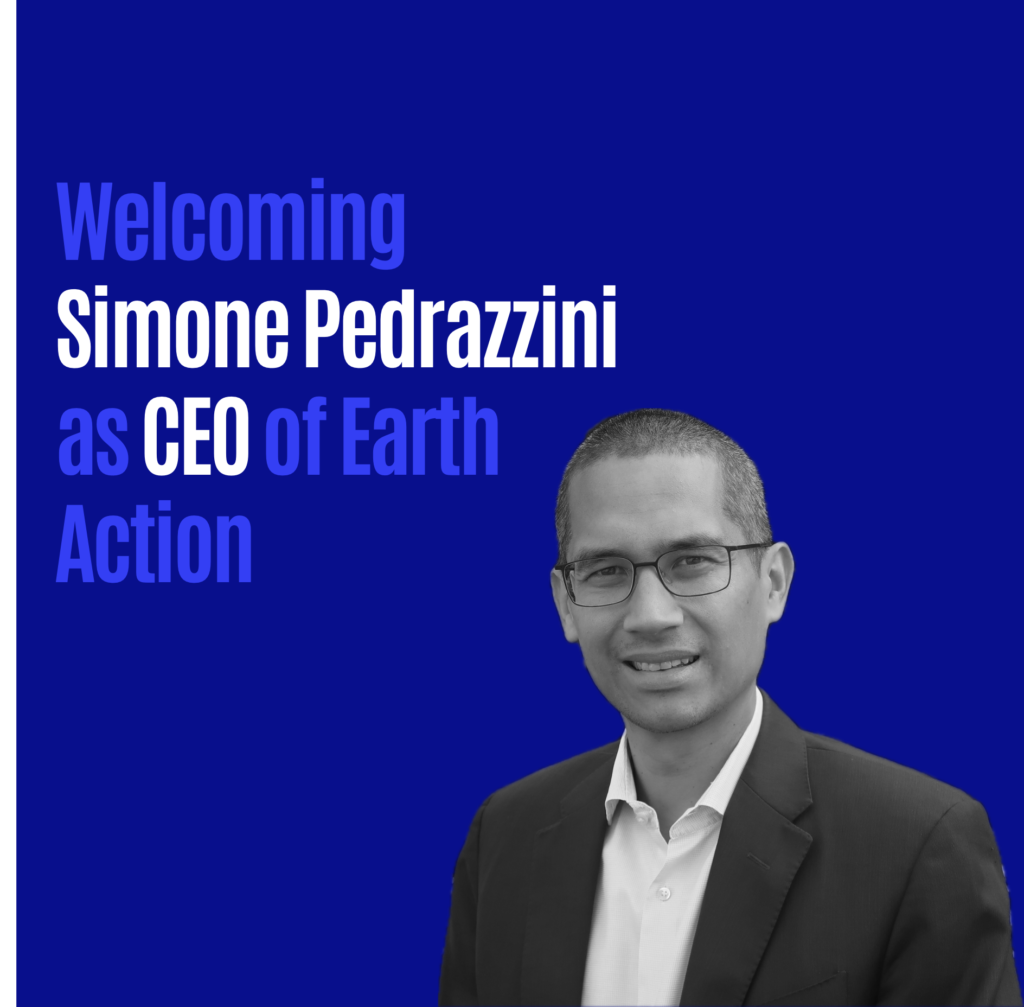
Today, we are proud to complete that picture. Simone Pedrazzini will be joining Earth Action as CEO in August 2026.
We have known Simone for years. He built Quantis Italy from zero, then took over Quantis Switzerland after the Boston Consulting Group (BCG) evolution when Arnaud moved into a broader Quantis-BCG role, scaling a team of remarkable people while never losing sight of the science or the mission. He is sharp, warm, deeply experienced, and aligned with what EA is here to do. Arnaud knows him better than almost anyone, having worked alongside him at Quantis for years.
Some people will ask what this means for Julien and Sarah. The honest answer: this is exactly what we planned for. We did not create EA to hold titles. We created it because we needed a platform to bring a vision to life. EA has grown to the point where the mission itself demands more than two founders can hold, not because we were lacking, but because the ambition is that large. Building an organisation with the kind of mission and manifesto we have requires many hands on the deck. Welcoming Simone is the fulfilment of that vision.
For Julien, this means more time on the science and methodology frontier: the work of building the tools, frameworks and knowledge that the whole field needs. For Sarah, it means deepening the partnerships and community that give EA its reach and its ability to drive systemic change. For both of us, it means more time doing what EA was built to do.
Part 1: Why now, and why Simone
Julien and Sarah: When you published the ‘looking for a CEO’ post in December 2024, you described wanting someone grounded, pragmatic, and deeply experienced. Where does Simone fit that description?
Julien: What we were really looking for was someone who has seen enough to not be surprised, but who is still energised by the challenge. Simone has spent over fifteen years in sustainability consulting, including leading Quantis Italy and then Quantis Switzerland through a decade of growth. He understands the complexity of this work from the inside. But what matters most to me is that he thinks systemically. He does not see sustainability as a compliance exercise or a reporting obligation. He sees it the way we do: as a fundamental reorganisation of how organisations understand risk, value, and their role in the world.
Sarah: When I think about what we wrote in December 2024, what stands out is this phrase: someone who believes that creating impact is about empowering others. That is Simone. He is the kind of leader who makes the people around him better. He has done it before, at scale, in exactly the kind of environment we are building. And honestly, having worked alongside Arnaud and knowing that Arnaud and Simone have built something together at Quantis, that gave us a level of confidence that is hard to manufacture any other way.
Arnaud: Simone and you worked together for years. What do you know about how he leads that the rest of us might not see on a CV?
Arnaud: What you see on a CV is the growth numbers and the titles. What you do not see is how he navigates ambiguity, how he holds a room when things are difficult, and how he makes people feel truly heard even when the answer is not what they hoped for. I have seen that firsthand: Simone built a team in Italy from nothing, and when I moved into a broader role, he was the person who took over Switzerland. That transition said everything. He stepped in without disruption, kept the culture intact, and kept the team moving. Simone is rigorous but never rigid. He has strong convictions but holds them lightly enough to be honestly curious about where he might be wrong. That combination is rare. And for a team like EA, where the work is intellectually serious and the culture is deeply collaborative, it matters enormously.
Julien: EA has two almost distinct sides: one that builds the science, the methodology, the data; and one that helps organisations apply it. How does Simone connect those two?
Julien: This is something I think about a lot. At EA, the science is not decoration, it is the foundation. But science that does not reach the organisations that need it has limited impact. For years, Sarah and I have tried to hold both sides. What Simone brings is the ability to be the bridge, credibly, in both directions. He understands what LCA actually means and how it is built. He also understands what a CEO, a CSO or a procurement director needs to hear, and how to make the conversation land. That translation capacity is what we need most at this stage.
Part 2: What this means for Julien and Sarah
Sarah: People will ask what changes for you personally. What is the honest answer?
Sarah: EA has grown into something that sincerely requires more than two people at the helm. That is not a problem, it is a sign that what we built matters. With Simone leading the organisation and Arnaud holding the internal structure, I can focus entirely on what I believe EA is most uniquely positioned to do: building the partnerships, the community, and the systemic connections that turn our work from good consulting into real field-level change. That is not a step back. That is the role I most want to play.
Julien: What I am most looking forward to is going deeper into the science again. That is where I started, and it is where I believe EA’s most important contribution still lies: not just applying existing methods, but pushing the methodological frontier, building the tools and frameworks the whole field needs. As EA has grown, more of my time has naturally gone into leading the organisation. With Simone as CEO, I can return to what I love most and what I think matters most: the research, the rigour, the scientific work that makes everything else EA does credible. I am extremely excited about that.
Part 3: Meet Simone, in his own words
1. You have spent over fifteen years in sustainability consulting. What has kept you committed to this space for so long?
What keeps me here, fifteen years in, is the cause which I love: a world where every economic decision enriches our house, the Earth, instead of depleting it. To keep living well in this house, for our society’s sake, we must take care of it. So must business. The real privilege is pursuing that cause not alone, but alongside passionate people moved by good intention. That conviction has shaped every choice and the best ones are rarely the obvious ones.
I remember starting my career in France as a Swiss engineer, or opening Quantis Italy in Milano from my dear Ticino. Voices warned against it, but as I said, the best choices are not always obvious. Leaving an ecosystem like BCG is not an obvious move either. Never chasing the trend, always setting the direction; that’s what fifteen years have taught me.
Today, that direction rhymes with EA: the strongest alignment I could have hoped for!
2. EA sits in an unusual position: part consultancy, part research organisation, part driver of systemic change. What drew you to that specific combination?
Sustainability consulting is going through a deep transformation. Short-term pressure is redefining the sustainability-momentum we had built over the past decade; at the same time, the advisory model itself is being rewritten from the inside by artificial intelligence. Navigating that demands three things and EA’s unusual position holds all three.
Real expertise, first. EA’s work isn’t about reactive compliance or generic reporting, but resilience-building and that takes real depth in the science. From Pack to Plate is a recent case in point: grounded in deep microplastic expertise, it challenges the assumptions we did not know we were making.
Unconditional commitment, second. EA for Impact, the non-profit arm, is not branding; it is structural proof that we never compromise our sustainability conviction.
And human fibre. The people I already know at EA have always been, to me, examples of humanity. That, almost paradoxically, is the strongest business asset when you want to build something that lasts.
This unusual position is, to me, deeply authentic.
3. EA is increasingly thinking about its work not just in terms of reducing footprints, but in terms of resilience: helping organisations understand where they are fragile, and build the capacity to withstand shocks. Does that framing resonate with you?
Absolutely it resonates: identifying where organisations are fragile and turning that into opportunity is our craft. A system optimised for performance under stable conditions is rarely robust under stress and that gap is exactly what our tools, grounded in life-cycle thinking, are built to map. EA’s framing around three dimensions — performance, impact and robustness — is the right lens for this moment.
Let me borrow from my Vietnamese roots and my expertise as a materials engineer: think of bamboo. Under load, it bends without breaking: exceptional elastic resilience. Under repeated stress, it resists fatigue where rigid materials would rupture. And in a sense it is antifragile: the wind that should snap it actually strengthens its fibres over time. That, to me, is what robustness looks like for an organisation that must navigate continuously shifting external conditions.
4. Arnaud has described himself as someone who enables visionaries to succeed. How do you see your own role, in your own words?
I see my role this way: rigorous organisation and planning are the foundation of every success, but it is flexibility that lets us reach better results.. We must take care of what is in our hands, and stay humble about what is not. That humility is, to me, the very beauty of life.
So I see myself as someone who embraces unpredictable surprises: they do surprise us, yes, but they also keep our way of playing free and agile, always ready to create something new. Sometimes it is good to think out of the box. Sometimes it is even better to think beyond it. The challenges of our time demand a serious dose of creativity, and the courage to follow it where it leads.
For me, leading is holding that balance: rigour where it matters, openness where it counts.
5. You are joining a team that has built something rare: scientific depth, genuine mission, and a culture people want to be part of. What do you want to add, rather than change?
What I hope to add is a mindset I already sensed in the team. In recent months, in conversations with Julien and Sarah, I felt a quiet, humble ambition: thinking about EA well beyond the next quarter. That resonated deeply. The way I see it, this is not a game we play for short horizons. It is one we want to keep playing, faithful to the mission, year after year, decade after decade.
The aim is not a stable company; stable too easily becomes frozen. The aim is a resilient one. An organisation that bends without breaking, that learns, that lasts. In my experience, that long-horizon mindset is what most invites trust, cooperation and the courage to innovate. That is what I hope to bring: not a new direction, but a longer life for the one already set admirably by Julien and Sarah.
6. What does engaging with EA look like for an organisation that has never worked with us before? What is the first conversation you would want to have?
I would start from organisations’ need today: anticipating regulation, strengthening supply chain resilience, creating value. But EA also offers what you may not always want to hear.
Regulation moves three steps forward, two back, one sideways. Yes, we help you navigate that jungle, but more importantly, we build the data foundations that keep you a step ahead however it evolves. Want to engage your supply chain? You can do that alone. But EA may also propose moving through sector-wide dynamics to advance the ecosystem: we work with anyone where intention comes first.
And sometimes we’ll raise uncomfortable topics, like microfibre shedding in textiles or microplastics in our plates, because that is where the greatest value lies: anticipating what the future will ask of you before it asks.
The best first conversation, though, happens in person, so find us at Sustainability in Packaging Europe (Barcelona 6-8 Oct 2026), Textile Exchange Conference 2026 (Vancouver 12-16 Oct 2026), Milano Fashion Week (Milano, September) and Sustainable Packaging Summit (Utrecht, 10-12 Nov 2026).
7. What does a ‘better normal’ look like for you, personally, right now?
A better normal, for me, is being truly present in the moment I am actually living. Not half-listening to my children while my mind drifts to the next thing. Not nodding through a conversation while already preparing my answer. Just being there, fully, with my family, with friends, with the people I serve through volunteering, and yes, with my future EA colleagues too.
It sounds simple, but I find it is one of the hardest things to actually live. Presence is a quiet discipline, and one I want to keep practising, because life does not happen later, it happens now.
So, a promise: next time we meet, the coffee is on me and I will be fully there. You will tell me afterwards how I did!
Closing
We are proud of the team we are building. Not just for what it allows EA to do today, but for what it signals about the kind of organisation we are becoming: one where great people have the space, the structure, and the mandate to do their best work.
If you have been following EA’s work and wondering whether now is the right moment to engage, Simone’s arrival is a good answer to that question.
We look forward to introducing him properly in August. Until then, you can read his interview above, and reach out to him directly on LinkedIn.