

Author : Noémie Voirin
The further it travels, the less we know
Every plastic footprint is a story about where things went. A company knows how much plastic it put on the market. It usually knows what it paid someone to collect. After that, the story gets vague, and the further you follow the plastic, the vaguer it gets, until you are estimating on top of estimates about what ended up in a river, a field, or the sea.
Companies set reduction targets on the strength of those numbers. Public authorities use the same accounting to decide what to build and what to regulate. So how far along the story the measurement can reach is not a technical detail. It determines what the target is worth.
Diana Ita-Nagy has spent almost ten years on the vague part. She is an industrial ecology researcher with the Peruvian Life Cycle Assessment and Industrial Ecology Network (PELCAN) at the Pontificia Universidad Católica del Perú, which means she studies how materials move through economies and what becomes of them once they leave. She also sits on the Scientific Committee of the Plastic Footprint Network, a group of more than forty organizations convened by Earth Action to agree on a single way of measuring plastic footprints. The committee is where researchers work on the methods behind the numbers.
Her toolkit is mostly life cycle assessment, the standard way of tallying a product’s environmental impacts from raw material to disposal, and material flow analysis, which tracks where physical material actually goes. She has pointed both at waste management and marine litter, and, further afield, at agriculture and fisheries. What ties the work together is an interest in the route rather than the destination, and above all in the moment plastic escapes into the environment. The field calls that leakage.
“A central part of my research is understanding how plastics move through socio-economic and environmental systems, from consumption and waste generation to leakage, transport, and accumulation in nature, together with the assessment of their potential impacts.”
That is a bigger job than it might sound. A footprint built only on the documented part of the route measures the part of the problem someone already had a receipt for. Diana is interested in the rest.
The part nobody wrote down
In much of the world, the paperwork stops early. Waste gets collected, sorted, and traded by people working outside any official system, and while the volumes are large, the records are thin or missing altogether. Measurement methods developed where the paperwork is good arrive expecting numbers that were never written down.
For a company, this is not an abstract problem. If your products are sold in those markets, the shakiest part of your footprint is the part covering the places where a good share of your plastic actually ends up.
Treating those places as a special case, to be dealt with once the method works elsewhere, would leave the method describing whichever systems happened to be easiest to observe. Diana came at the problem from the other end. She joined MariLCA, an international research effort working out how marine litter and microplastics can be represented in life cycle assessment, during her PhD, and Global South contexts made the gap obvious. Waste management there tends to be less specialized, it has characteristics nobody has studied in enough depth, and so it barely features in the methods used to assess it. On the Scientific Committee she works on metrics that fit those contexts from the start.
She is also, plainly, enjoying watching the network grow.
“I also find it fascinating seeing the growth of the PFN over time, and its potential to create meaningful change.”
The place that growth is most needed is the stretch of the route nobody can see clearly yet.
Where the trail goes cold
The hardest question, in her account, sits at the far end of that route. Once plastic slips out of a managed system, where it goes, how much of it moves through the air, how much through soil, how much down a river to the coast, is still only partly understood. That stretch also happens to be the one that decides whether a footprint means anything.
“We are still working to measure more precisely the flows of plastics along their value chains, including their mismanagement and leakage into nature.”
She has already built part of the answer. In a 2022 paper in the Journal of Industrial Ecology, written with Ian Vázquez-Rowe and Ramzy Kahhat, she set out a way to estimate how much plastic a river basin actually delivers to the ocean, accounting for the natural features and built structures that hold waste back or carry it along. Applied to the Piura region of Peru, the method put the figure between 4.2 and 13.9 kilograms per person per year for 2018.
That spread is the honest state of the science, and it is the argument for standardizing the measurement. A company or a government working from the low end of that range and one working from the high end would reach different conclusions about what needs building.
Same waste, two answers
Not knowing where plastic goes is one problem. Not agreeing on how to measure it is another, and it makes the first one worse. Two teams can sample the same waste stream and come back with figures that cannot sit in the same table, because there is no agreed way of measuring and sampling plastic waste to begin with.
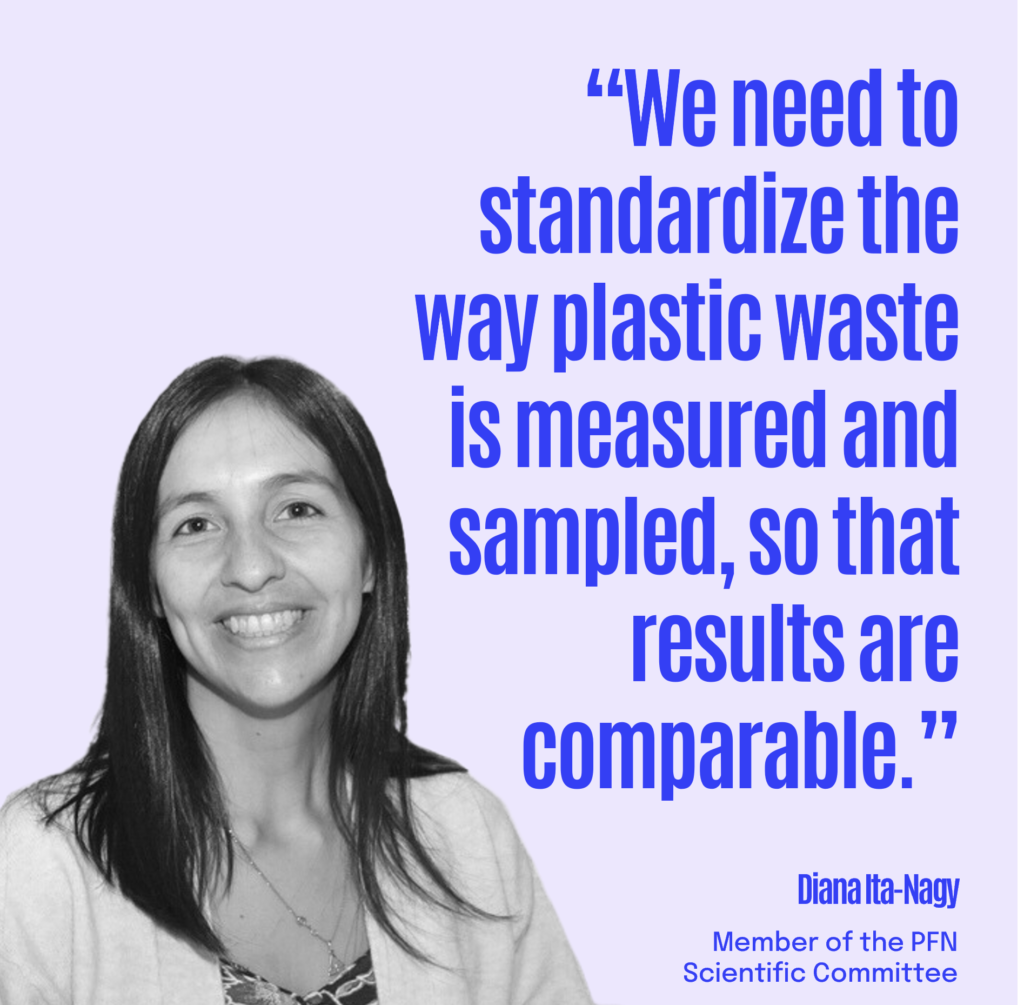
“We need to standardize the way plastic waste is measured and sampled too, so that results are comparable, can be aggregated, and can support more robust decision-making.”
For anyone reporting a footprint, that is the difference between a number and a baseline. If the method shifts between years, sites, or suppliers, the trend line says as much about the measuring as it does about the plastic.
Comparable numbers are what let someone act on them, and that is where she sees the network earning its keep.
“One important role is to develop a common language and methodological foundation for measuring plastic footprints.”
This matters well beyond research. A company deciding where to spend, or a ministry deciding what to build, needs the same definitions and the same starting and stopping points as everybody else. That is what makes it possible to find the hotspots, rank them, and pick interventions that actually work. Otherwise, the priorities they set are an artifact of how they counted.
Counting what leaves the economy
Her next question turns the accounting around. Plastic that leaks is normally counted as pollution. It is also material that has walked out of the economy, and counting it that way changes what the number tells you.
“I am particularly interested in assessing plastic leakage from a resource perspective, as this could provide a different way of understanding resource mismanagement and plastic dissipation.”
Alongside that she is following the physical route further: how plastics cross from land into water, and what happens once they settle. Life cycle assessment barely covers any of that yet. Both threads run the same way, toward a footprint that still means something past the point where the paperwork stopped.
Acting on the system you have
None of this is a reason to wait for better numbers. Her advice splits along the route she studies. Companies should be working on how much plastic they use and how much of it escapes along their supply chains, and getting more of it back at the end of a product’s life. Governments should be building collection and treatment for the conditions they will actually meet, not the ones in the manual.
“The needs and conditions of the Global South are not the same as those of the North, so strategies cannot simply be transferred from one context to the other.”
It is the same point she makes about metrics, in a more practical register. A strategy is built for a particular system, and it stops working when you move it somewhere that behaves differently. A packaging change that pays off where collection is reliable is not automatically a win in a market where nothing collects that packaging afterwards.
A metric that travels
She is not glib about the scale of the problem. What has changed, in her view, is the company she keeps. Plastic pollution is now treated as a serious environmental threat, and the people who can do something about it are increasingly in the same room.
“There is growing awareness that no single actor can solve this problem alone, and that science and policy action should be interconnected.”
Her contribution to the network is a methodological one with a geography attached. A footprint carries the assumptions of the system it was built for, and those assumptions have to match the system in front of you. Getting the metrics to hold where waste management is informal is what makes plastic footprinting credible anywhere else, including for the companies relying on those numbers to set a target and defend it.
To explore PFN’s tools, datasets, or assess your own plastic footprint, visit plasticfootprint.earth or contact the network at contact@plasticfootprint.earth.