

Author : By Sarah Perreard, Co-founder & Stakeholder Engagement Lead at Earth Action, and Scott Voisey, Principal Product Manager at Matter
When Earth Action published From Shedding to Solutions in July, one figure was easy to misread. Universal tertiary wastewater treatment, adopted globally across every textile facility, was modelled to reduce total microfiber leakage by just 6%. On its own, that looks like a disappointing result for a solution the industry has invested heavily in. It isn’t. It’s a finding about where the fiber goes, not about whether treatment works.
Three tiers, one gap
Wastewater treatment isn’t one thing. Facilities run some combination of primary treatment (physical removal of solids), secondary treatment (biological breakdown of organic matter), and tertiary treatment, further filtration that captures much finer particles, including microfibers. The report models a global shift to universal tertiary treatment across all industrial facilities, reaching capture rates of up to 97 to 99% in high-income countries and around 91 to 92% in lower-income ones.
Innovative point-source filtration technologies can provide high levels of microfiber capture, bringing performance associated with tertiary treatment into the primary stage of a facility’s existing system. Solutions such as Matter’s Regen system can improve capture while also creating operational efficiencies that can reduce treatment costs. By lowering the cost barrier to improved capture, these approaches have the potential to support wider adoption and, ultimately, greater impact. The report’s own methodology notes describe this as a distinct lever, improving capture within a facility’s existing system. It’s worth naming, because it’s the lever many mills can act on now. The modelling remains unchanged, as it is based on overall removal performance rather than where within the treatment system that removal happens.
Wastewater treatment therefore plays a critical role in mitigating microfiber pollution. What isn’t captured in wastewater treatment will flow into the environment. Upgrading treatment systems with tertiary treatment or comparable point-source technologies capable of capturing over 90% of microfibers, such as Matter’s Regen system, is therefore a key step in preventing upstream microfiber emissions. Capture is an important part of the equation; the other is effective sludge management.
Capture isn’t containment
Here is the mechanism behind the 6% figure. Under the modeled scenario, universal tertiary treatment cuts aquatic leakage by roughly 82%, meaning less fiber reaching rivers and oceans. But sludge disposal practices were held at baseline in that scenario, and most captured fiber worldwide still isn’t managed responsibly. So the fiber that treatment keeps out of the water mostly ends up routed into sludge instead, and from there, back onto land. Total environmental leakage barely moves, because the fiber didn’t disappear. It changed compartments.
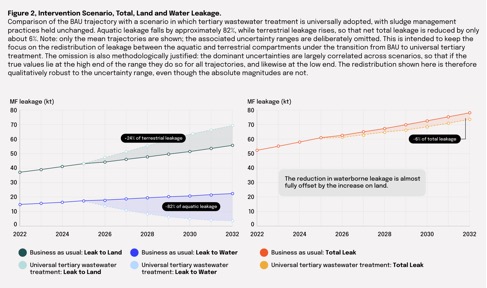
Figure 1: Wastewater treatment alone, water vs. land leakage, 2022 to 2032 (source: From Shedding to Solutions, Figure 2). Under a scenario where all facilities adopt tertiary treatment but sludge disposal stays at business-as-usual levels, aquatic leakage falls by about 82% while terrestrial leakage rises by a similar magnitude. Read together, the two lines show redistribution, not reduction: total leakage falls by only 6%.
“We separated wastewater treatment and sludge management into two figures in the report because each needed to be shown honestly on its own terms. But read in isolation, that separation risks under-selling the case for infrastructure that does both.”
Sarah Perreard, Co-founder & Stakeholder Engagement Lead, Earth Action
Sludge management, the underrated lever
Move in the other direction and the picture flips. Modeled on its own, moving all facilities to controlled sludge containment (secure landfill or incineration, rather than uncontained land application) reduces total leakage by approximately 43%, the largest single-lever effect in the report. That’s what the baseline currently leaves on the table: most of what treatment already captures is not yet disposed of safely.
Current sludge practices vary widely and reporting on them is still maturing, one more reason coordinated investment in both capture and containment matters now, not later.
What happens when they’re paired
The report’s own text makes the point plainly: “The full benefit is realized when tertiary treatment is paired with controlled sludge containment and disposal.” Modelling the two levers together, tertiary wastewater treatment plus controlled sludge management, without any additional gain from process optimization, points to a reduction in total leakage of 94% by 2032 relative to the BAU baseline, just a point behind the report’s own Ideal scenario (95%), which adds manufacturing process optimization on top. The breakdown is the real story: aquatic leakage falls by 82%, identical to treatment alone, since that reduction comes from capture, not disposal. What changes is what happens on land. Under treatment alone, terrestrial leakage rises by 24% as captured fiber gets redirected into uncontrolled sludge. Under the combined scenario, it falls by 98% instead, because that same captured fiber now stays contained.
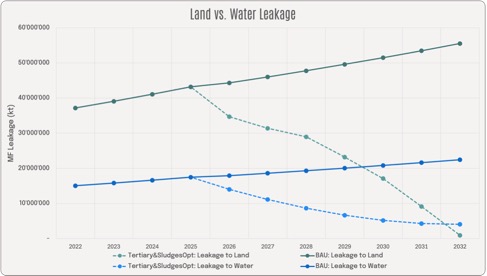
Figure 2: Combined wastewater treatment and sludge management, water vs. land leakage, 2022 to 2032 (source: Earth Action modelling, August 2026). Aquatic leakage falls by 82% by 2032, the same reduction achieved by treatment alone, since capture rates are unchanged. Terrestrial leakage falls by 98% instead of rising, because fiber that treatment captures is now safely contained rather than redirected into uncontrolled sludge. Total leakage falls by 94% overall.
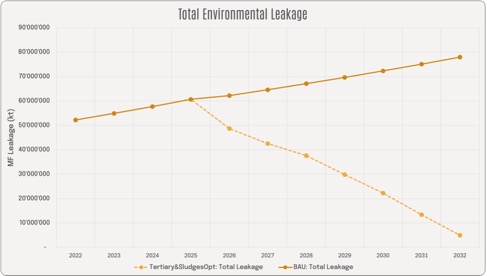
Figure 3: Total environmental leakage, business as usual vs. combined wastewater treatment and sludge management, 2022 to 2032 (source: Earth Action modelling, August 2026). The combined scenario (dashed) diverges from business as usual (solid) after 2025 and falls to roughly 5 kt by 2032, a reduction of 94% against a BAU trajectory of about 78 kt, without any additional gain from process optimization.
“Effective wastewater treatment and sludge management are two essential parts of the same equation. Bring them together, and we have a highly effective means of preventing microfiber emissions, and importantly, these solutions are available for adoption today.”
Scott Voisey, Principal Product Manager, Matter
Why the starting point matters
The right lever depends on where a facility sits today. A mill running only primary treatment with uncontrolled sludge disposal has sludge management as its single biggest opportunity. A mill already running secondary treatment with sludge already landfilled has captured most of that benefit already; its remaining lever is a tertiary-level upgrade, or comparable point-source technologies of the kind described above. Neither case is solved by funding one side of the system and assuming the other will follow.
The takeaway for brands and investors
Wastewater treatment and sludge management aren’t competing line items in a sustainability budget. They’re two halves of the same intervention, and infrastructure investment that funds one without the other leaves most of the benefit unrealized. Fund them as one investment, not two, and a reduction on the order of 94% is achievable with technology available today.
Get in touch at contact@e-a.earth or visit www.e-a.earth to read the full From Shedding to Solutions report, or reach out to Matter directly to talk about microfiber and wastewater filtration enquiries@matter.industries or visit www.matter.industries.