

Author : Noémie Voirin
Counting tonnes is not enough
Plastic pollution is often measured in tonnes: how much is produced, how much is used, how much ends up as waste. Amila Abeynayaka, member of the PFN Scientific Committee, spends much of his work complicating that picture.
With a background in civil engineering, he moved into environmental engineering and policy research, building a strong focus on science-based policymaking. Since 2018, he has worked mainly on plastic pollution, microplastics, chemical additives, and their environmental impacts, paying particular attention to how scientific evidence can support practical action in both Global North and Global South contexts.
“My work spans laboratory studies, computer-based modelling, quantitative sustainability assessment, particularly life cycle assessment, and the science-policy interface. A central part of my work is identifying the data, indicators, and assessment methods needed to inform policy at global, regional, national, and local levels.”
For Amila, this means combining empirical evidence from laboratory studies with modelling approaches to improve inventory data on plastic emissions, while communicating uncertainty clearly and avoiding burden shifting across life-cycle stages, regions, and impact categories.
A network that keeps evolving
Amila first encountered the Plastic Footprint Network (PFN) while conducting research in Japan, where he followed the methods and modules PFN had developed for assessing plastic footprints. His interest grew as the framework expanded to cover additional emission sources, including textiles, agricultural plastics, and tyre wear. When his colleague Elena Corella (co-chair of the Technical & Scientific Committees) invited him to join the PFN Scientific Committee, he saw it as a valuable opportunity to contribute his experience.
What excites him most is the network’s iterative, collaborative approach.
“PFN’s methods continue to evolve through feedback from scientists, industry, policy researchers, and other stakeholders, helping to keep them both scientifically credible and practically relevant. PFN also provides structured outputs based on the best available science, giving research groups a common language and reference point from which to advance further studies.”
For Amila, the Scientific Committee is a space to connect expertise across disciplines, contribute to practical outputs in sectors where guidance is increasingly needed, including construction, agriculture, and recycling, and learn alongside the wider PFN community.
What do we actually mean by “plastic”?
Ask Amila about the hardest question in footprinting, and he starts somewhere more basic than most people expect.
“A key challenge begins with a basic question: what do we actually mean by ‘ plastic’? It is not only the polymer. A plastic product may also contain additives, fillers, pigments, processing aids, coatings, and many other chemicals, while its footprint depends on its composition, how it is made, its function, how it is used, and what happens at the end of life.”
In many cases, the full composition of a product remains unknown, even though a very large number of chemicals are associated with plastics. Quantifying a footprint requires understanding what is actually present, where releases may occur, and what environmental or human-health impacts may follow, information that is rarely available in full.
When less plastic doesn’t mean less impact
The same uncertainty carries over into reduction strategies, and this is where Amila is most direct.
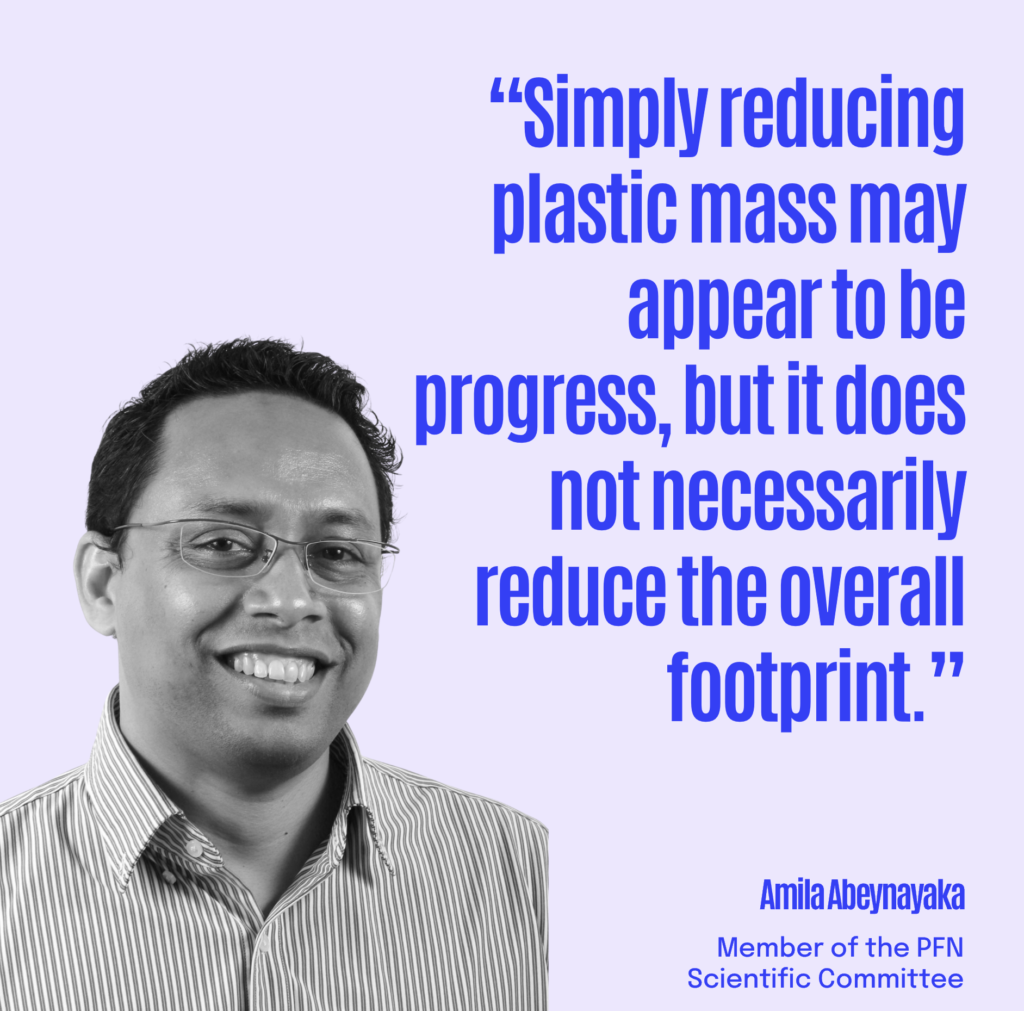
“Simply reducing plastic mass may appear to be progress, but it does not necessarily reduce the overall footprint. It may instead shift burdens to another material, formulation, life-cycle stage, region, or impact category.”
Regional context compounds the problem. Consumer behaviour, collection systems, recycling capacity, waste-management infrastructure, and environmental conditions all differ considerably from one place to another. For Amila, meaningful reduction requires a broader, evidence-based assessment of composition, functionality, use context, emissions, and impacts, one that acknowledges what remains unknown rather than assuming it away.
From measurement to meaningful reduction
So what does a scientifically sound plastic footprint assessment actually require? Not simply a count of how much plastic is used or discarded, Amila argues.
“We need common definitions, clear system boundaries, reliable inventories of where plastic is used and released, and methods that help us understand the resulting environmental and potential human-health impacts, and resource use.”
This is where he sees PFN’s role: bringing scientists, industry, policymakers, and practitioners together to build a shared and practical framework. But one method cannot serve packaging, textiles, agriculture, construction, and tyre wear equally well, since each source involves different release pathways, data needs, and assumptions. PFN’s sector-specific modules make these differences visible. The tyre module, for instance, shows how a complex emission source can be broken down into a system map, key parameters, data requirements, and modelling assumptions.
Beyond measurement, Amila sees PFN helping organizations identify where emissions occur, what they can control or influence across the value chain, and which interventions are most likely to reduce actual impacts, including circular economy strategies such as reduction, reuse, repair, longer product lifetimes, and improved recycling, provided these deliver real environmental, human-health, and resource benefits rather than simply moving the problem elsewhere.
Bridging Global North and South
Looking ahead, Amila wants to explore how plastic footprints can be reduced across sectors without discouraging useful innovation or creating new burdens elsewhere. This includes long-life products, circular economy strategies, and better ways to assess environmental impacts, human-health risks, and resource use together.
“I am also keen to explore how solutions developed in Global North contexts can be adapted to Global South realities, and how scientific findings can be translated more effectively into policy and practical decision-making.”
That translation work, from evidence to policy that fits local conditions, is where he sees some of the field’s most important progress still to be made.
Why he stays optimistic
Despite the scale of plastic pollution, Amila remains optimistic, and his reasoning is specific.
“What keeps me optimistic is the growing recognition that plastic pollution is not only a waste problem, but also a challenge linked to product design, production, chemical safety, consumption, and wider systems. Compared with a decade ago, stakeholders are more aware of these connections and more willing to collaborate across science, industry, policy, and society.”
Assessment methods are also becoming more practical and transparent. Many uncertainties remain, but Amila is clear that this is not a reason to wait.
His advice to businesses and policymakers follows the same logic:
“Manage plastics through a full life-cycle and value-chain perspective: look beyond material mass, understand product composition and function, track supply chains and how products are actually used and managed after use, and assess environmental impacts, human-health risks, and resource use together.”
Done well, he says, this avoids shifting burdens to other materials, regions, or life-cycle stages, and supports clearer targets, better monitoring, and more practical circular economy outcomes.
To explore PFN’s tools, datasets, or assess your own plastic footprint, visit plasticfootprint.earth or contact the network at contact@plasticfootprint.earth.