

Author: Noémie Voirin
Seeing what we still don’t measure
Plastic pollution is widely recognized as a global challenge, yet much of its environmental impact remains difficult to quantify. For Valentina Pauna, a researcher representing NORSUS in the Plastic Footprint Network (PFN) Scientific Committee, the core issue is clear: we still lack critical data to understand where plastics go and what they do once released into the environment.
With a background in microplastic impacts on marine ecosystems and life cycle assessment (LCA) method development, her work focuses on closing these gaps so plastic footprints reflect real environmental outcomes rather than simplified estimates.
“On paper, my expertise is microplastic impacts on marine ecosystems. In practice, it means identifying and filling the most important data gaps in plastic-related environmental assessment.”
By improving datasets and methodologies, her research helps move footprinting from broad assumptions toward more realistic representations of environmental impacts.
From leakage to impact: the measurement challenge
Measuring plastic footprints is not straightforward. Plastics are lightweight, mobile, and degrade into smaller particles, making them difficult to track across value chains and ecosystems. In addition, limited transparency around waste logistics often restricts access to reliable data.
For Valentina, the challenge is not only technical but systemic. While reduction strategies exist from a logistical perspective, they require rethinking production and consumption systems that have been optimized over decades.
“The difficulty is not just measuring plastics but understanding their fate. Reduction is less a logistical issue and more a behavioral one – it requires a paradigm shift in how we produce, source, and package goods.”
This shifts the conversation from end-of-pipe solutions toward upstream design choices and the use of more locally sourced and produced goods.
Mapping plastic fate with better tools
A major focus of Valentina’s work has beenis developing more realistic maps of plastic pollution pathways and impacts. Using improved computational tools and more granular data, she aims to understand how plastics move through environments and where they accumulate.
Better fate mapping allows footprint models to move beyond generic assumptions and reflect context-specific risks — a critical step for designing effective mitigation strategies.
PFN as a platform for collaboration
Valentina emphasizes that no single discipline can solve plastic pollution. PFN’s strength lies in bringing together experts from different fields — LCA, ecology, material science, industry, and policy — to build consistent and actionable methodologies.
“PFN is a unique platform for collaboration. Connecting different areas of expertise is essential to finding real solutions to plastic pollution.”
This collaborative approach helps translate complex scientific insights into tools that organizations can apply in practice.
Working with uncertainty while driving action
Valentina speaks candidly about the emotional dimension of working on plastic pollution. Progress can feel slow relative to the scale of the problem, yet she finds encouragement in the growing community committed to addressing it.
Her work also highlights an important reality: even advanced footprint models rely on incomplete information. When uncertainty remains high, the most effective strategies are those that reduce risk across the entire system.
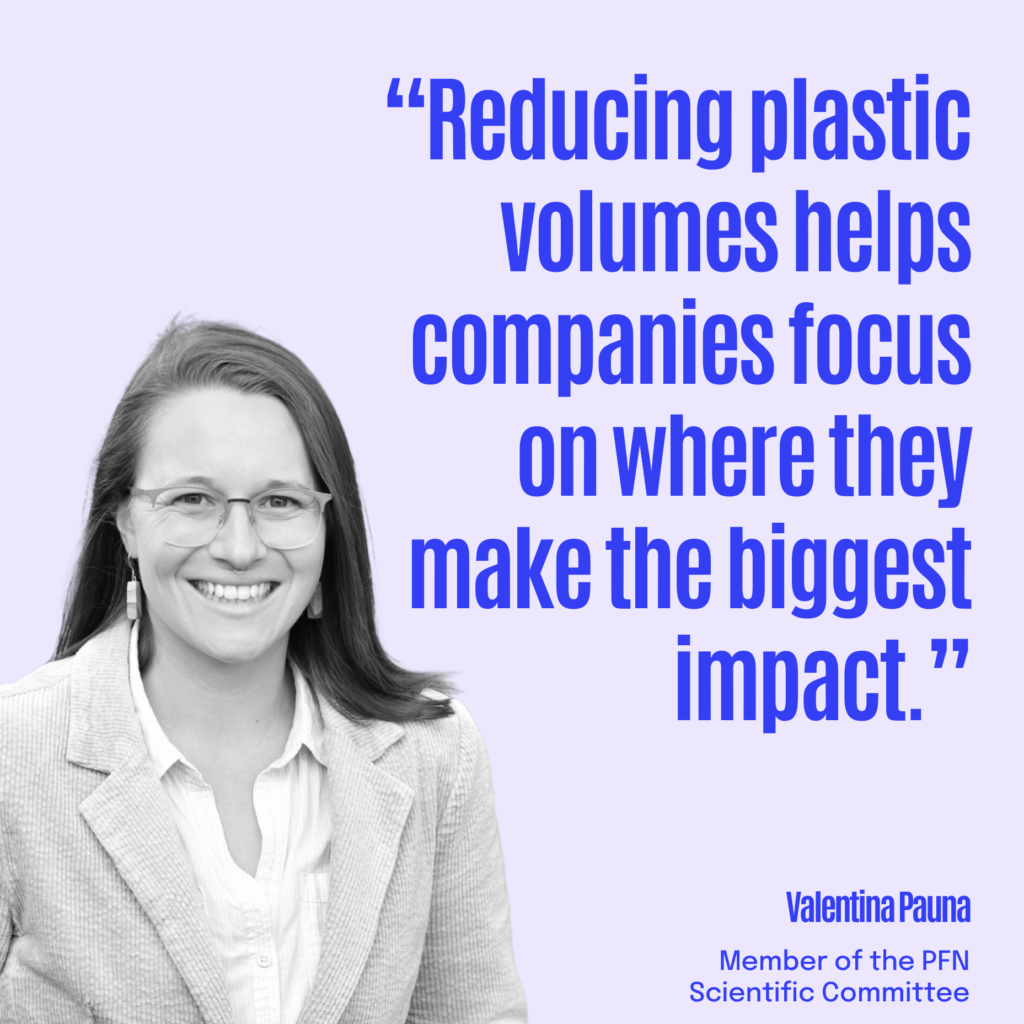
This means prioritizing upstream action — in sourcing, product design, and packaging — rather than relying solely on downstream waste management. Lower volumes reduce potential leakage regardless of where it occurs and help companies focus on reduction where it delivers the greatest risk and impact benefits.
A simple principle for complex systems
When asked what this means in practice for businesses and policymakers, her advice is deliberately concise:
“Use less.”
In the context of her research, this is not a slogan but a risk-reduction strategy. Lower volumes mean fewer unknowns about fate, fewer opportunities for leakage, and a smaller overall environmental burden — even where current models still carry uncertainty.
From better data to better decisions
By improving data quality, mapping plastic fate more accurately, and fostering collaboration, PFN’s work — and Valentina’s contributions — help organizations move from rough estimates to meaningful action.
For businesses, this means identifying where plastic use can be reduced or redesigned across the value chain. For policymakers, it means supporting systems that prioritize transparency, local production where appropriate, and circular strategies.
To explore PFN’s tools, datasets, or assess your own plastic footprint, visit plasticfootprint.earth or contact the network at contact@plasticfootprint.earth.