

Author : Noémie Voirin and Sarah Perreard
Plastic pollution is often framed as a waste problem. But long before a product becomes waste, critical decisions have already been made — in material selection, design, sourcing, and performance requirements.
Maider Iturrondobeitia Ellacuria works precisely at that upstream frontier.
Specialized in ecodesign, circular economy strategies, and life cycle assessment (LCA), she focuses on transforming recycled and bio-based plastics into products that are not only technically sound, but genuinely environmentally preferable. As a member of the Scientific Committee of the Plastic Footprint Network (PFN), she contributes to advancing credible and harmonized methodologies to measure plastic impacts across value chains.
We spoke with Maider about circular design, the complexity of plastic footprinting, and why scientific rigor is non-negotiable if we want real progress.
From marine waste to high-performance materials
Maider’s work sits at the intersection of material science and environmental assessment.
Her focus: integrating recycled polymers, including those recovered from marine environments, into new products that meet strict technical requirements while reducing environmental burdens.
“It’s not enough for a material to be recycled,” she explains. “It has to perform. It has to be safe. And it has to demonstrably reduce impacts when you look at the full life cycle.”
This is where life cycle thinking becomes essential. By combining material innovation with LCA, she evaluates trade-offs across climate, resource use, toxicity, and end-of-life scenarios. She also works on developing bio-based and biodegradable materials, always with the same principle in mind: substitution alone is not a solution.
“You cannot assume a material is better just because it is bio-based or recycled. You have to measure it.”
Why plastic footprinting is so difficult
If carbon accounting is complex, plastic footprinting is even more fragmented.
“One of the biggest challenges is harmonizing methodologies,” Maider says. “Plastics vary enormously in composition, additives, uses, and end-of-life fate. Each of these factors changes the environmental profile.”
Leakage into the environment adds another layer of difficulty. Definitions vary. Monitoring systems differ by region. Data gaps are significant. Microplastics and additives further complicate impact assessment.
And then comes the substitution dilemma.
“If you reduce plastic use without looking at the full system, you may create new environmental problems elsewhere.”
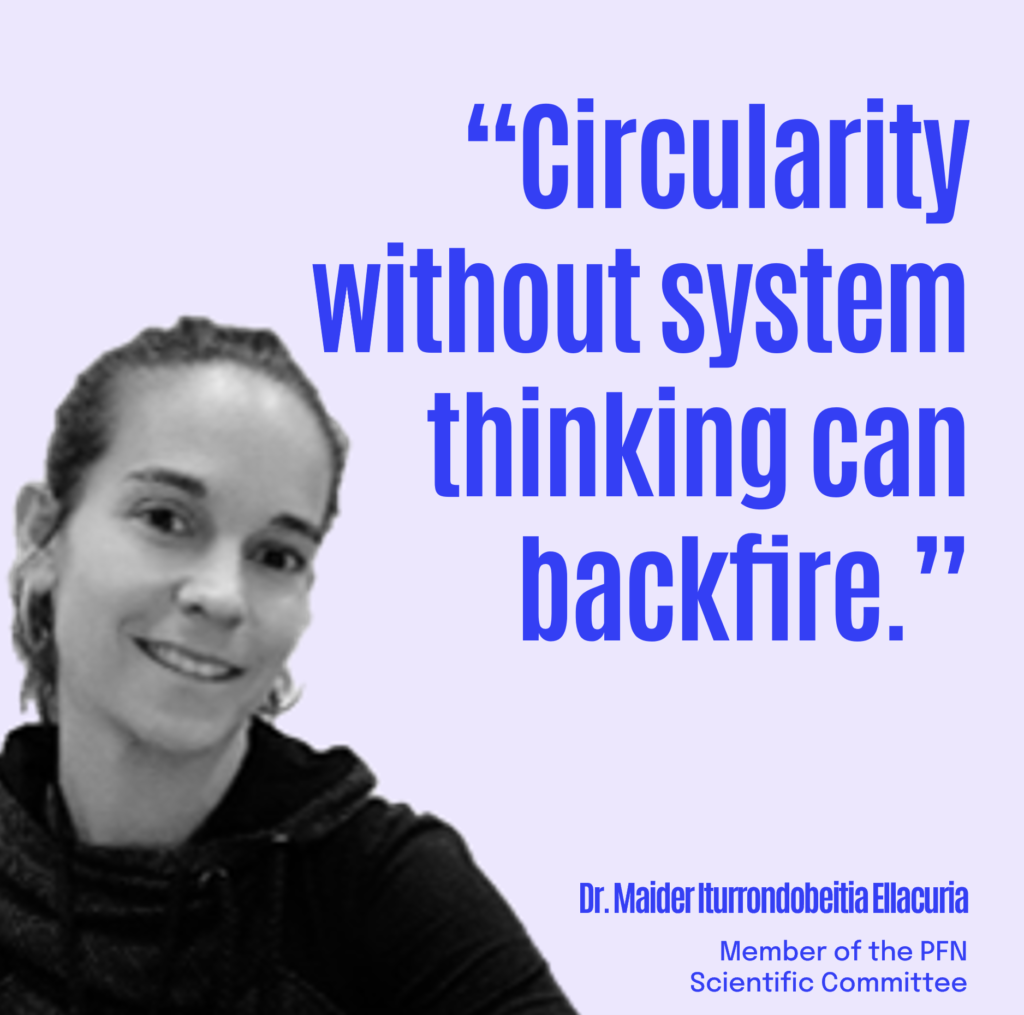
In other words, circularity without system thinking can backfire.
PFN’s role: building shared language and credible metrics
Maider joined PFN through her research on plastic circularity and impact measurement along value chains. What motivates her most is not just the science, but the collaboration.
“The strength of PFN is that it brings together scientists, practitioners, and organizations around a shared objective: comparable, transparent, and credible methodologies.”
In a field where definitions and metrics are still evolving, this harmonization is critical. Without it, companies cannot set meaningful targets, policymakers cannot design effective regulation, and progress cannot be compared across sectors.
PFN’s work helps establish a common language around plastic use, leakage, recovery, and mitigation — grounding ambition in scientific robustness.
“It’s about aligning expertise with practical needs,” she says. “We need tools that are rigorous, but also usable.”
Designing for real circularity
Looking ahead, Maider sees major potential in integrating real-time data and digital traceability into ecodesign processes.
Digital product passports, advanced tracking systems, and improved data infrastructure could make it easier to keep materials in circular loops — and to measure what actually happens to them.
But technology alone will not solve the problem.
“We need clearer frameworks, better data systems, and stronger collaboration between businesses and policymakers.”
Her advice is disarmingly simple:
“Measure first. Then act based on evidence.”
For businesses, that means designing products with their full life cycle in mind and committing to transparent material flows. For policymakers, it means investing in harmonized standards and infrastructure that make circularity feasible.
Collaboration over fragmentation
Despite the scale of plastic pollution, Maider remains cautiously optimistic.
“The level of awareness, collaboration, and innovation has never been higher.”
But no single organization can solve the crisis alone. Progress depends on shared methodologies, transparent data, and cross-sector cooperation.
PFN embodies that philosophy: advancing plastic footprinting not as a branding exercise, but as a scientific foundation for credible action.
If we want circularity to be more than a slogan, measurement must come first.
And as Maider reminds us, science is not a barrier to action. It is what makes action meaningful.
For readers interested in exploring PFN’s tools or understanding their own plastic footprint, you can visit plasticfootprint.earth or contact the network at contact@plasticfootprint.earth to learn more.