

Authors : Charlotte Stalder & Marguerite Fauroux
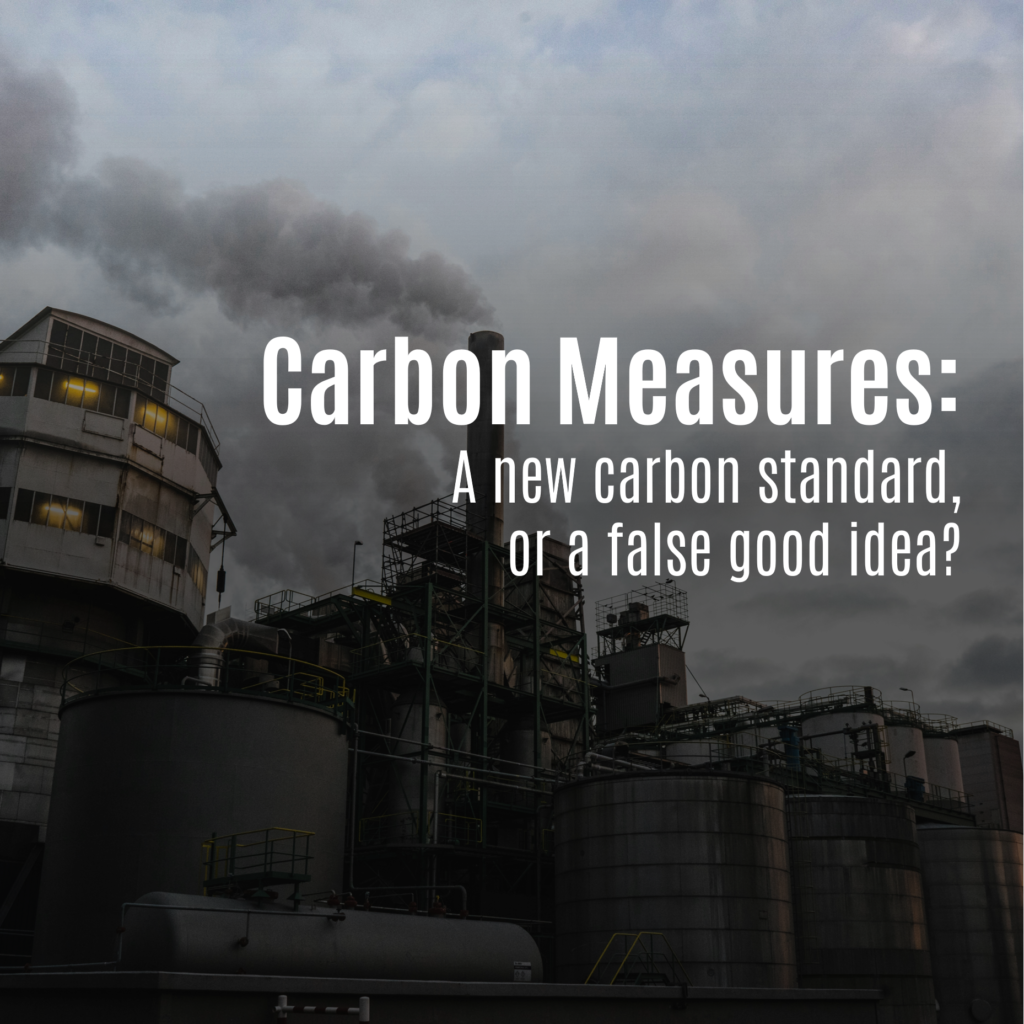
Carbon Measures: an industrial coalition aiming to redefine carbon accounting
Officially launched in 2025, Carbon Measures is a global coalition bringing together major players from the energy, finance, and industrial sectors, including ExxonMobil, BlackRock, BASF, Air Liquide, and Banco Santander. Its ambition is clear: to develop a new carbon accounting framework, presented as more precise, more consistent, and capable of becoming an international reference.
At first glance, the initiative fits into a familiar context. Carbon data has become central. It shapes investment decisions, regulatory requirements, transition pathways, and strategic trade-offs. The idea that better measurement leads to better decisions is, in itself, hard to dispute.
Yet how emissions are measured is never a purely technical matter. Measurement frameworks shape responsibility, guide action, and determine what becomes politically and economically possible. For this reason, Carbon Measures deserves careful and critical scrutiny.
Why create a new carbon standard?
Today, the GHG Protocol forms the backbone of global carbon accounting. Developed by the World Resources Institute, it is used by companies, financial institutions, and regulators worldwide. It underpins climate strategies, reporting obligations, and net-zero pathways.
Carbon Measures argues that this framework has reached its limits and highlights three main shortcomings:
- double counting, where the same tonne of CO₂ can be claimed by multiple actors along the value chain,
- lack of precision, particularly in measuring the carbon intensity of key products such as electricity, steel, cement, or fuels,
- and limited comparability, due to heterogeneous methodologies and assumptions.
These criticisms are real. But they are neither new nor overlooked. They have been debated for years among scientists, practitioners, and regulators. The question, therefore, is not whether the GHG Protocol is imperfect. It is, like any framework applied to complex systems.
The real question is whether creating a new standard is the right response to these limitations today.
When methodological solutions become strategic problems
Proposing a new carbon standard does not simply mean refining an existing tool. It means reopening fundamental discussions around boundaries, rules, assumptions, and the use of carbon data.
In practice, this implies:
- years of development,
- pilot phases,
- methodological trade-offs,
- and a prolonged period of uncertainty about which framework truly matters.
In today’s context, this uncertainty is not neutral. Companies are already facing growing regulatory pressure, heightened investor expectations, and strong operational constraints to define and implement credible decarbonization pathways.
When measurement becomes an endless construction site, it stops being a lever for action and turns into a factor of delay. Methodological sophistication, far from accelerating the transition, can end up slowing down real-world implementation.
The risk of structural greenwashing
The composition of the Carbon Measures coalition raises a central issue: governance.
A carbon standard is never innocuous. It produces very concrete effects.
It determines what is counted, what remains out of scope, who bears responsibility, and where regulatory and economic pressure is applied.
To be credible, a carbon framework must be independent, transparent, and scientifically validated. Despite its limitations, the GHG Protocol benefits from this legitimacy. It is widely recognized by regulators, markets, and the scientific community, and it is governed by a non-partisan organization.
Creating an alternative standard driven by major industrial interests, without strong guarantees of independence and governance, exposes a risk of structural greenwashing. Not necessarily through data manipulation, but through the subtle shaping of rules, boundaries, and priorities.
When the architects of the problem seek to redefine the rules
The questions raised by Carbon Measures are not only methodological. They are also historical.
Several companies behind this coalition are among those that have contributed disproportionately to global emissions over decades. More importantly, they have played a central role in shaping the climate debate itself.
Some of these actors were aware very early on of the climate risks associated with their activities. Rather than immediately adjusting their strategies, they participated for years in approaches that delayed action, shifted the debate, or diluted its economic and regulatory implications.
These approaches have taken many forms over time: questioning scientific trajectories, emphasizing methodological uncertainty, focusing on future or marginal solutions, or progressively shifting responsibility toward other actors in the system.
In this context, seeing these same companies position themselves today as co-designers of a new carbon accounting standard cannot be assessed independently of this history. The issue is not to deny the possibility of change or good faith at an individual level. It is to recognize that methodological frameworks shape the pace and direction of climate action, and that those who design them have a decisive influence on what becomes acceptable, urgent, or deferrable.
Multiplying standards dilutes climate action
Carbon Measures enters an ecosystem already saturated with frameworks: the GHG Protocol, ISO standards, SBTi, CDP, European regulatory frameworks, and numerous sectoral methodologies. This proliferation is not a technical detail. It has very real consequences.
First, it weakens comparability. Companies can select the frameworks that best suit them, blurring the interpretation of progress and undermining the credibility of transition pathways.
Second, it consumes significant resources. Entire teams spend their time navigating methodologies, audits, assumptions, and justifications, instead of implementing concrete emission reduction measures.
Finally, it delays decisions. The more complex measurement becomes, the more action is postponed. In a context of climate urgency, this delay is far from trivial.
Multiplying standards does not automatically increase rigor. It fragments collective effort and dilutes impact.
The illusion of perfect emissions attribution
The debate around emissions attribution is not new. For years, it has been one of the key arenas where climate responsibility is negotiated.
Assigning each tonne of CO₂ to a single entity may appear scientifically rigorous. In practice, the pursuit of perfect attribution has often served to shift responsibility rather than strengthen action. By focusing on “who owns” a tonne of emissions, the more decisive question is sidelined: who actually has the power to reduce it?
It is no coincidence that this debate has been strongly promoted by actors whose business models rely on high emission volumes. Shifting responsibility downstream, toward consumers or end users, reduces pressure on upstream structural decisions such as product design, investment choices, technologies, and volumes placed on the market.
Take the example of a combustion-engine car.
Should emissions be attributed to the manufacturer, the fuel producer, or the final user?
In reality, multiple actors influence the same tonne of CO₂. Their levers of action are not symmetrical:
- companies control structural levers such as design, investment, and innovation,
- consumers operate within constraints shaped by supply, infrastructure, and pricing.
The GHG Protocol acknowledges this complexity through Scope 3, conceived as a scope of influence rather than exclusive responsibility. The goal is not to assign blame, but to identify where action is possible and where its impact potential is highest.
Improving without fragmenting
The current limitations of carbon accounting call for improvement. But improvement does not require creating a new standard.
Existing levers already exist:
- strengthening governance and independence of existing frameworks,
- clarifying the use of scopes as tools for analysis and action,
- better distinguishing between measurement, responsibility, and contribution,
- accepting a degree of uncertainty instead of promising illusory precision,
- and refocusing carbon accounting on its primary purpose: enabling fast and structural emissions reductions.
Conclusion
This debate is not theoretical.
For companies committed to credible decarbonization pathways, choosing a carbon accounting framework is a strategic decision, not an academic exercise.
Today, creating or adopting a new carbon standard does not accelerate climate action. It weakens it. It diverts resources, complicates comparability, and delays decisions that must be taken now.
The GHG Protocol is not perfect. But it is recognized, operational, and embedded in the regulatory frameworks that already shape investment, reporting, and transformation decisions.
In the current context, moving away from it is an unnecessary risk.
At Earth Action, we make a clear choice:
strengthen what exists rather than fragment,
work with imperfect but actionable frameworks,
and focus energy where it truly matters: rapid and structural emissions reductions.
The climate transition will not fail for lack of standards.
It will fail if the search for new frameworks becomes a substitute for action.
This is not the time to reinvent carbon accounting.
It is time to use it to transform, now.